The short version
- "Reduces PFAS" printed on a box means nothing. Certified to NSF/ANSI 53 or 58 for PFAS reduction means everything.
- Your water utility already publishes a free test report every year. Read it before you spend a dollar.
- Basic carbon pitchers mostly make chlorine taste go away. That's a fine thing to buy, it's just not PFAS removal.
- A certified $30 pitcher beats an uncertified $600 system. Reverse osmosis is the heavy hitter if your water actually needs it.
In April 2024, the EPA did something it had never done in its history: it set enforceable federal limits on PFAS "forever chemicals" in drinking water, capping PFOA and PFOS at 4 parts per trillion. By then 3M had already agreed to pay public water systems between $10.3 and $12.5 billion over PFAS contamination. Filter marketing departments noticed all of this immediately.
So the filter aisle now splits into two products that look identical: filters independently certified to remove PFAS, and filters that make water taste nicer while the box gestures at purity. Price will not tell you which one you're holding. The certification letters will.
One more reason this is on you for now: the 2024 rule gave utilities years to come into compliance, and Washington has been renegotiating parts of it since, though the PFOA and PFOS limits have so far survived. Whatever happens at the treatment plant, it happens slowly. A filter at your tap is the bridge.
Step zero: read the free report your utility already sent you
Every community water system in the US is required to publish a Consumer Confidence Report each year, and it's free. Search your utility's name plus "consumer confidence report," or check the paper copy that comes with a bill. It tells you what's actually been detected in your water: lead, PFAS, disinfection byproducts, or nothing much at all.
This matters because the right filter depends on your actual problem. Plenty of people are about to spend $600 fixing chlorine taste, which a $25 pitcher handles. Others have PFAS detections and are "fixing" them with a filter that was never designed to touch them. Ten minutes of reading first. Then shop.
The letters that matter: 42, 53, and 58
NSF/ANSI standards are the closest thing this industry has to a lie detector. Certification means an independent body (NSF, WQA, or IAPMO) tested that specific model against a specific claim and keeps auditing it. The standard number tells you what was tested.
| Label | What it actually covers | What it means at your sink |
|---|---|---|
| NSF/ANSI 42 | Aesthetics: chlorine taste, odor, particulates | Water tastes better. No health claim at all. |
| NSF/ANSI 53 | Health contaminants: lead, cysts, and (where certified) PFOA/PFOS reduction | The one to look for on pitchers and under-sink carbon filters. Check which contaminants the specific model is certified for. |
| NSF/ANSI 58 | Reverse osmosis systems | The heavy-hitter category. Covers RO performance, including PFAS reduction claims where certified. |
The trap: a filter can be legitimately certified under NSF/ANSI 42 for chlorine and say "NSF certified" in big letters while removing zero PFAS. That's not fraud, it's just a different test. Always ask: certified to which standard, for which contaminant? Every real certification is searchable in NSF's, WQA's, or IAPMO's online listings.
Pitchers: most improve taste, a few do real work
A standard carbon pitcher is a chlorine-and-taste device. Useful, cheap, and honest as long as nobody pretends otherwise.
Some pitchers go further and have the paperwork. ZeroWater's pitchers are certified to NSF/ANSI 53 for PFOA/PFOS reduction and cost around $25 to start; the honest caveat is that their five-stage filters exhaust quickly, so replacement cartridges quietly become the real price. Clearly Filtered's pitcher carries WQA certification for PFOA/PFOS reduction with a much longer filter life, but you'll pay several times more upfront. Both beat any uncertified "advanced filtration" pitcher at any price.
If your Consumer Confidence Report shows no PFAS and no lead, a basic certified-for-42 pitcher is a perfectly rational purchase. Buying it to fix taste is smart. Buying it to fix PFAS is a category error.
Whichever way you go, the certification has fine print you have to honor: it assumes you replace cartridges on schedule. An exhausted carbon filter stops capturing what it was certified to capture. If you're the household that runs a pitcher filter for eight months on vibes, set a calendar reminder or buy the model that shouts at you. The lapsed filter is the quietest way to turn a good purchase into a placebo.
Reverse osmosis: the heavy hitter with real tradeoffs
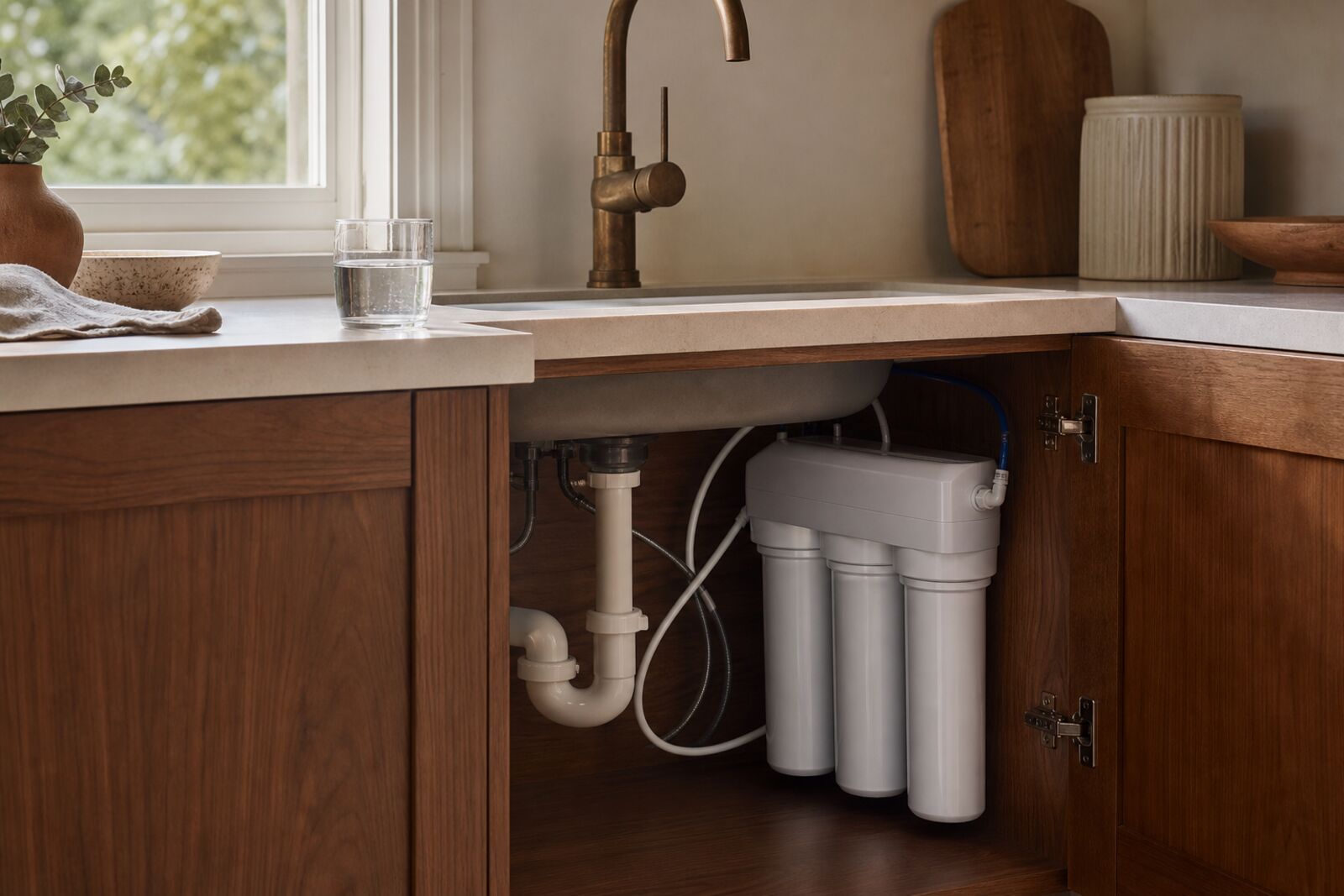
Reverse osmosis pushes water through a membrane fine enough to reject most dissolved contaminants, and it's the most capable residential technology for PFAS. Look for NSF/ANSI 58 certification with an explicit PFAS reduction claim on the model you're buying.
The tradeoffs are real but manageable: RO systems send some waste water down the drain, take up under-sink space, need periodic membrane and filter changes, and strip minerals along with contaminants, which some people notice as a flat taste. Under-sink units from major brands commonly run a few hundred dollars. For a household with confirmed PFAS in the report, this is where we'd spend.
The $600 mistake, and the whole-home question
The classic mistake in this aisle is the expensive uncertified system: a tank and some cartridges, an impressive website, the word "military-grade" somewhere, and no listing in any certification database. If a company can't point you to third-party certification for the specific contaminant you care about, walk away at any price.
Whole-home systems deserve their own honesty check. Companies like Shell Water Systems sell whole-house and reverse osmosis setups that typically run in the $2,500 range installed, and there are legitimate reasons to want one: well water, iron staining, water so hard it's eating your appliances, or chlorine smell in every shower. But for the headline worry, PFAS in your drinking glass, whole-home treatment is overkill for most people. You drink from one or two taps. A certified point-of-use filter at the kitchen sink does that job for a tenth of the money. If you do go whole-home for other reasons, the same rule rules: certification paperwork for the specific contaminant, or no sale.
Bottom line
Read your utility's free Consumer Confidence Report before buying anything. If PFAS or lead shows up, buy a unit certified to NSF/ANSI 53 or 58 for that specific contaminant, whether it's a $30 pitcher or an under-sink RO. Skip anything, at any price, that can't show you the certificate.