The short version
- A 2024 Columbia study found roughly 240,000 plastic particles per liter of bottled water, about 90% of them nanoplastics. Nobody knows yet what that does to a person.
- Airplane galley water comes from tanks with a documented history of coliform hits, which is why the crew skips the coffee.
- Domestically, a refillable bottle filled after security handles the plastic count, the cost, and the taste.
- Abroad, the question is microbes, not microplastics, and a filter bottle is not a purifier bottle.
240,000 particles, and what the number doesn't say
In January 2024, Columbia researchers published a paper in PNAS that changed the numbers everyone had been using. Applying stimulated Raman scattering microscopy, a technique that adds a second laser to pick up particles previous methods couldn't resolve, they counted an average of about 240,000 plastic fragments per liter of bottled water. Roughly 90% were nanoplastics, small enough that earlier surveys never saw them. The total came in 10 to 100 times higher than prior estimates.
Here's the part that got lost in the coverage. That study was a detection breakthrough, not a health finding. It measured particles. It did not measure harm, and the researchers didn't claim to. A subsequent PNAS letter argued the method needs more careful blank controls, since laboratory plastic can contaminate the samples you're counting. Meanwhile the World Health Organization's 2019 review of microplastics in drinking water concluded that at the levels found, the health risk appeared low, while being candid that the data were thin and the methods inconsistent.
So the honest position: the counts are far higher than we thought, the significance is unknown, and the reasonable response is to stop buying a product that's demonstrably the worst option on the metric, not to panic about the water you've already drunk. WHO's review also found bottled counts running higher than tap, some of it introduced by the bottling and the cap.
Why flight crews don't drink the coffee
Aircraft potable water lives in an onboard tank, gets filled from ground trucks and airport hydrants, and moves through plumbing that's harder to service than a building's. EPA wrote the Aircraft Drinking Water Rule, in force since 2011, precisely because testing kept turning up problems in those systems.
The most useful public accounting is the 2019 Airline Water Study from Hunter College's NYC Food Policy Center, which scored 11 major and 12 regional US airlines on a five-point Water Health Score built from fleet age, ADWR violations, positive coliform and E. coli samples, and whether the airline would answer questions about its water at all. The researchers set 3.0 as the line for reasonably safe water. Alaska and Allegiant scored at the top, Hawaiian close behind, JetBlue and Spirit at the bottom.
That study is now several years old and fleets change, so treat the specific rankings as history rather than a current scoreboard. The structural point holds: coffee and tea are the only things served from the tank. Canned and bottled drinks never touch it. If you want one rule for flying, it's that the free coffee is the one item on the cart with a documented reason to skip it.
The bottle that solves the domestic version
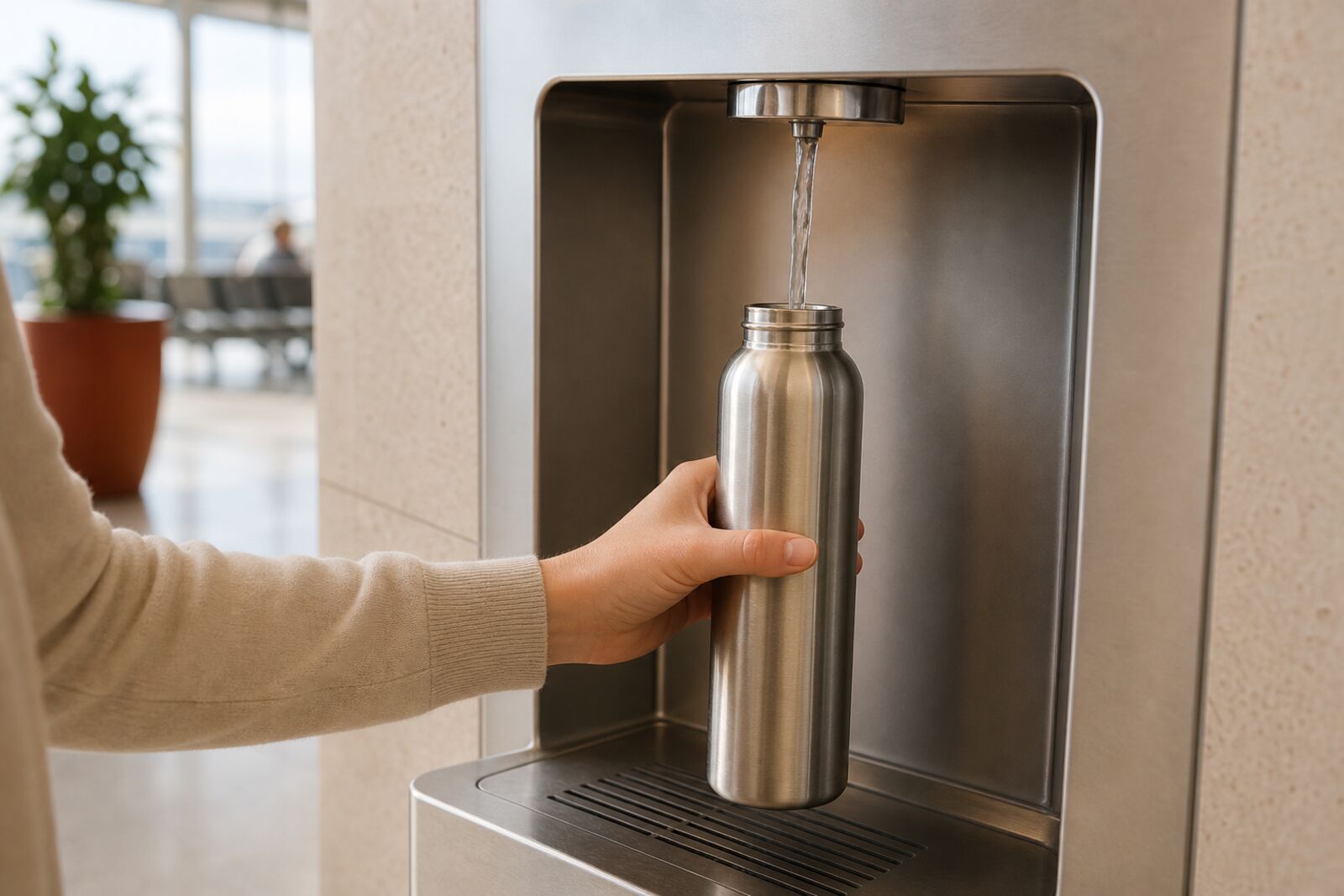
Bring an empty bottle through security and fill it at the terminal. That's it. That's the entire domestic answer, and it wins on plastic particles, on cost, and on the fact that you'll actually drink more water on a dry plane if you're not rationing an eight-ounce cup.
TSA lets empty bottles through, and most large US airports now have bottle-filling stations mounted on the fountains, usually near the restrooms in each concourse. Steel or glass avoids the plastic question entirely, though steel gets dented and glass is a liability in a bag full of chargers. A hard plastic bottle is still fine. The particle counts that made the news came from single-use PET and the bottling line, not from a bottle you fill yourself and wash.
One habit worth adding: ask the flight attendant to fill it from a sealed bottle rather than the galley pitcher. Most will, cheerfully, and it saves you the tank question entirely.
If your objection to tap water is taste, a carbon filter bottle is the right tool. Brita's bottle filter is certified under NSF/ANSI 42 for chlorine taste and odor, which is a real certification for a real, narrow claim. Understand what it isn't: it's not certified to remove bacteria, protozoan cysts, or viruses, and it isn't sold as though it is. For US municipal water, that's a good match, because the pathogens are already handled and the chlorine is the thing you're tasting.
Abroad, the enemy changes
In places where tap water isn't potable, the risk isn't nanoplastics. It's E. coli, giardia, cryptosporidium, hepatitis A, norovirus. Those will ruin a trip in a way that a particle count never will, and they need different hardware.
A filter and a purifier are not the same category. Hollow-fiber filters like LifeStraw's remove bacteria and protozoa but generally do not remove viruses, which are small enough to pass through the membrane. In regions where viral contamination is a live concern, that gap matters.
Grayl's GeoPress is the press-style purifier most travelers land on: the company reports removal of 99.99% of viruses, 99.9999% of bacteria, and 99.9% of protozoan cysts, plus an activated carbon stage for chemicals, heavy metals, and taste, and it produces 24 ounces in about eight seconds. The tradeoffs are honest ones. It's heavy for its volume, it costs several times what a normal bottle costs, and the cartridge needs replacing on a schedule you have to actually track.
And when the local water infrastructure is the problem, sealed bottled water is the correct choice, full stop. Choosing a microbiological risk to avoid a hypothetical particle risk is not sophistication, it's a category error. Perfect is not the enemy of safe.
Two things not worth your attention
Refilling a single-use plastic bottle for a week isn't the crisis the internet says it is, though the cap threads get grimy and the plastic scratches, which is a hygiene reason to stop, not a chemical one.
And boiling doesn't remove plastic particles. It kills organisms, which is a different job. If you're boiling water on the road, do it for the microbes and don't expect it to solve anything else.
Bottom line
Carry a refillable bottle and fill it past security, and add a carbon filter if your only complaint is chlorine taste. For destinations where the tap isn't safe to drink, buy a proper purifier that states virus removal, or drink sealed bottled water without guilt. Skip the plane coffee, which is the one piece of onboard folklore with real regulatory history behind it.