The short version
- A bamboo toothbrush is a packaging swap, not a dental upgrade. The bristles are still nylon, and they don't compost.
- Charcoal-infused bristles have no clinical evidence behind them. They're a color.
- The floss swap is the one with an actual study attached, and it's still a small one.
- What moves your dental outcomes: two minutes, twice a day, soft bristles. That's the whole list.
A bamboo toothbrush costs about what a plastic one costs, photographs better on a marble counter, and will not make your teeth one degree cleaner. That's fine. It was never supposed to.
The problem is that the bathroom-swap economy blurs two very different claims into one warm feeling. Some swaps genuinely reduce plastic. Some swaps genuinely reduce a chemical exposure. And some swaps just reduce the amount of time you spend feeling bad in the personal care aisle, which is a real service but shouldn't cost you $14.
So here's the honest ranking. Every swap gets one of three grades: free win (costs nothing extra, does something real), fine if you like it (harmless, marginal, buy it for pleasure), or pure vibes (the benefit is the sticker).
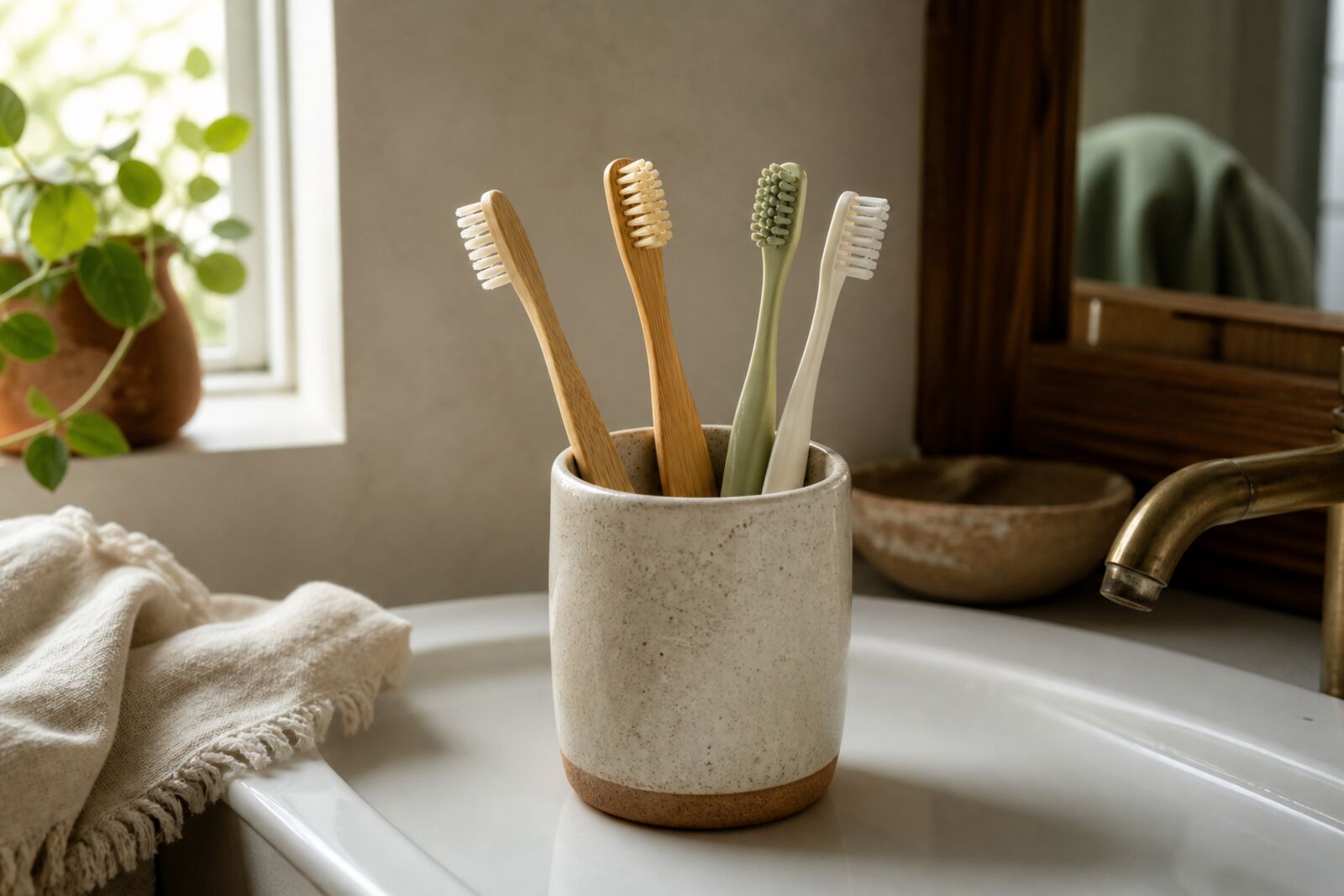
The bamboo handle is a waste win. The bristles are still plastic
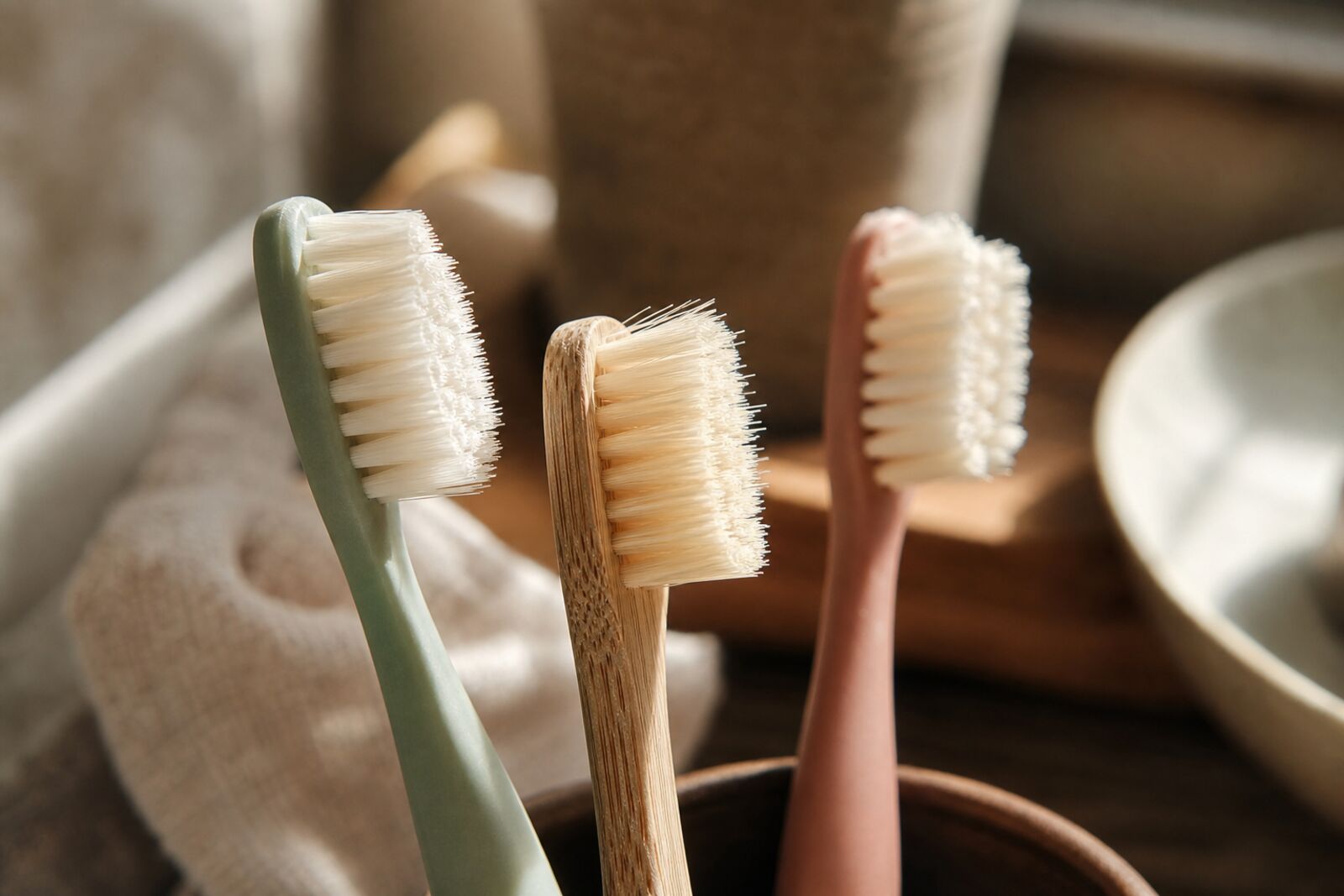
Here's the part the packaging tends to whisper. The handle is bamboo and will break down in a home compost pile. The bristles on essentially every bamboo brush on the market are nylon, either petroleum-based nylon-6 or a castor-oil-derived nylon marketed as plant-based. Neither one biodegrades in your backyard bin.
Which means the actual instruction, buried on the back of the box, is: pull every bristle tuft out with pliers, recycle or bin the nylon, then compost the handle. Almost nobody does this. Most bamboo brushes go into the trash whole, where the handle rots and the bristle head sits there like any other piece of plastic.
That's still better than a solid plastic handle. Roughly the same brush, a fraction of the polymer. Just don't let it turn into a health claim, because the bristles do the cleaning and the bristles are identical.
Grade: free win, with an asterisk shaped like a pair of pliers.
Charcoal bristles are the beauty industry's gray sticker
Charcoal-infused bristles show up on maybe half the bamboo brushes sold, usually with words like "antibacterial" and "naturally whitening" nearby. There is no peer-reviewed clinical evidence that charcoal-infused bristles remove more plaque, kill more bacteria, or whiten anything compared with plain soft nylon.
The wider charcoal story isn't better. A 2017 literature review in the Journal of the American Dental Association looked at charcoal and charcoal-based toothpastes and concluded there was insufficient clinical and laboratory data to back up the safety and efficacy claims being made, including the whitening and antibacterial ones. The ADA has been openly skeptical of charcoal dentifrices since, largely over abrasivity: scrubbing enamel with a gritty paste can expose dentin, which reads as more yellow, not less.
To be fair about dose: that abrasion worry belongs to charcoal paste, not to charcoal baked into a bristle. Gray bristles aren't hurting you. They're just not doing anything.
Grade: pure vibes.
Floss is the swap with a real study behind it
In 2019, researchers from the Silent Spring Institute and the Public Health Institute published a study in the Journal of Exposure Science and Environmental Epidemiology measuring 11 PFAS compounds in the blood of 178 middle-aged women and matching those levels against everyday behaviors. Flossing with Oral-B Glide was associated with higher blood levels of PFHxS, one of the longer-lived PFAS.
The same team ran 18 flosses through gamma-ray emission spectroscopy looking for fluorine. All three Glide products they tested came back positive, consistent with the long-reported fact that Glide-type floss is made with a Teflon-family polymer, expanded PTFE, which is what makes it slide.
Now the honest caveats, because this study gets cited far past what it says. It's 178 women. The behavior data is self-reported. It's an association, not a measured dose moving from floss to bloodstream, and the authors were careful about that. PTFE itself is an inert plastic, not the same thing as the processing chemicals PFAS refers to.
But this is a case where the swap is genuinely free. Plain nylon floss costs the same, cleans the same, and skips the question entirely. Silk floss is the compostable option if you want it, though it is, by definition, not vegan.
Grade: free win, as long as you don't let the swap become a reason to floss less. Flossing at all beats flossing with the correct brand.
Tongue scrapers, safety razors, and shampoo bars
A tongue scraper is $10 of bent metal with one small Cochrane review behind it, from 2006, covering two trials and a grand total of 40 participants. Scrapers produced a statistically significant reduction in volatile sulfur compounds compared with brushing the tongue, and the reviewers described the evidence as weak and unreliable. The effect also wasn't detectable more than 30 minutes after use in any group. So: it works, briefly, on breath. Buy one if you enjoy it.
The safety razor is the sleeper. Cartridge razors are mixed metal and plastic fused into a sharp object, which is why no municipal recycling program in the US will take them. A double-edge blade is a single piece of steel that goes into a blade bank and then into scrap metal, and blades run pennies apiece against several dollars a cartridge. You will hear that the EPA estimates 2 billion razors get landfilled annually in the US. That number traces to a 1990 EPA consumer handbook, and the agency now says it doesn't track it, so treat it as folklore with a plausible shape rather than a current statistic. The waste logic holds without it.
Shampoo bars are a packaging story and should be sold as one. If the bar is true soap, its high pH can leave a film on hair in hard water, and people blame their hair for that. If it's a syndet bar, it behaves like the liquid version in a smaller box.
| Swap | What it actually does | Grade |
|---|---|---|
| Bamboo handle | Cuts plastic per brush. Bristles still nylon. | Free win |
| Charcoal bristles | Nothing measurable. | Pure vibes |
| Non-PTFE floss | Sidesteps one small PFAS signal, same price. | Free win |
| Tongue scraper | Short-term breath improvement, thin evidence. | Fine if you like it |
| Safety razor | Real waste and cost reduction. | Free win |
| Shampoo bar | Less packaging. Formula depends on the bar. | Fine if you like it |
The boring thing that outranks all of it
The American Dental Association's guidance is unglamorous and unchanged: brush two minutes, twice a day, with soft bristles. The ADA draws no distinction between manual and powered brushes in that recommendation, and its own systematic reviews found two minutes of brushing removes meaningfully more plaque than one.
The ADA Seal of Acceptance is the least exciting signal on the shelf and the only one that requires a company to hand over evidence of safety and efficacy to a scientific council. It's not a purity mark and it doesn't say anything about the handle material. It just means somebody checked.
Which is the pattern across this whole category. The swaps that matter tend to be about material and waste. The swaps that get marketed hardest tend to be about the color of the bristles.
Bottom line
Take the bamboo handle, the safety razor, and the non-PTFE floss, because all three cost the same or less than what they replace. Skip the charcoal bristles and buy the tongue scraper only because you want one. Then go brush for the full two minutes, which is the only item on this list your dentist will ever notice.