The short version
- The FDA's September 2016 rule pulled triclosan, triclocarban, and 17 other actives from consumer soaps after makers couldn't show they were safe, effective, or better than plain soap.
- Soap works by lifting germs off your skin and rinsing them away. Killing was never the job.
- "Antibacterial" soaps still exist using deferred ingredients like benzalkonium chloride. Same pitch, still no proof of superiority.
- Alcohol sanitizer (60 percent or more) is legit when there's no sink. It was never part of the ban.
In September 2016, the FDA told the makers of antibacterial soap to knock it off. Not because triclosan, the category's star ingredient, had been proven to hurt anyone, but because after four decades of selling extra protection, the companies never produced evidence that their soaps beat plain soap and water. The agency asked for receipts. There weren't any.
The rule, in plain English
The final rule, issued September 6, 2016, removed 19 active ingredients from consumer antiseptic washes, with triclosan (the liquid soap favorite) and triclocarban (the bar soap version) as the headliners. It covered products meant to be used with water: liquid, foam, and gel hand soaps, bar soaps, and body washes. Health care antiseptics and hand sanitizers were handled separately. This wasn't a niche cleanup, either. By the FDA's estimate at the time, roughly 40 percent of soaps on the market contained at least one of the affected ingredients.
The legal standard was simple. To stay in these products, an ingredient had to be generally recognized as safe and effective, and "effective" here meant showing a benefit over ordinary soap and water. The FDA had formally requested that data when it proposed the rule in 2013, at the end of an argument dating to the 1970s. Manufacturers either didn't run the studies or didn't submit them. They got a year to reformulate, and by September 2017 the ingredients were out of soap.
Read that standard again, because it's the quiet scandal of the story. The products weren't pulled for being proven dangerous. They failed the easier test: prove this does anything.
The case against triclosan wasn't just "useless"
Zero benefit would have been reason enough, but question marks piled up on the other side of the ledger too. Animal studies linked triclosan to altered thyroid hormone levels. Microbiologists worried that soaking the world in a germ-killing chemical at everyday doses is a good way to train resistant bacteria. And exposure was near-universal: CDC biomonitoring found triclosan in roughly three quarters of the urine samples it tested.
Dose discipline still applies, so let's apply it. None of those signals amounted to demonstrated harm in humans at hand-soap doses, and the FDA's decision didn't depend on them. That's the clean logic of the whole episode: when the measurable benefit is zero, any nonzero question mark loses the trade.
And the famous "kills 99.9 percent of germs" claims weren't fabricated. They were lab-true. But killing microbes in a dish was never the same claim as fewer infections in a household, and the household evidence is what never materialized.
Where triclosan went after the ban
The 2016 rule only covered antiseptic washes, so triclosan didn't vanish; it relocated. Most famously, it stayed in Colgate Total toothpaste, the only US toothpaste that contained it, for more than two years after the soap rule. Toothpaste sat outside the rule, and Total, to be fair, had something antibacterial soap never did: efficacy data behind an FDA-reviewed claim, for fighting gingivitis. Colgate reformulated anyway, relaunching the line in January 2019 as Total SF with stannous fluoride, while insisting the timing had nothing to do with the controversy. Triclosan also spent years as the "antimicrobial" treatment in cutting boards, socks, and gym gear, uses governed by entirely different rules. Minnesota, for what it's worth, didn't wait for Washington: the state passed its own triclosan ban in 2014, ahead of the federal rule.
The loophole still on the shelf
Walk a soap aisle today and you'll still find "antibacterial" on labels, because three replacement ingredients (benzalkonium chloride, benzethonium chloride, and chloroxylenol) were deferred from the 2016 rule to give manufacturers time to produce the missing safety and effectiveness data. Products built on them stayed on the market in the meantime. So the pitch on today's antibacterial bottle is identical to triclosan's old pitch, and the proof of superiority is in the same place triclosan's was: pending.
Alcohol-based hand sanitizer is the legitimate cousin in this family. It's a different product category the rule never touched, it genuinely kills germs on contact, and the CDC recommends it, at 60 percent alcohol or higher, for moments when there's no sink. Note the built-in fine print: when there's no sink. Where soap and water are available they win, and for some bugs sanitizer handles poorly, like norovirus, it isn't close.
Soap never needed an upgrade
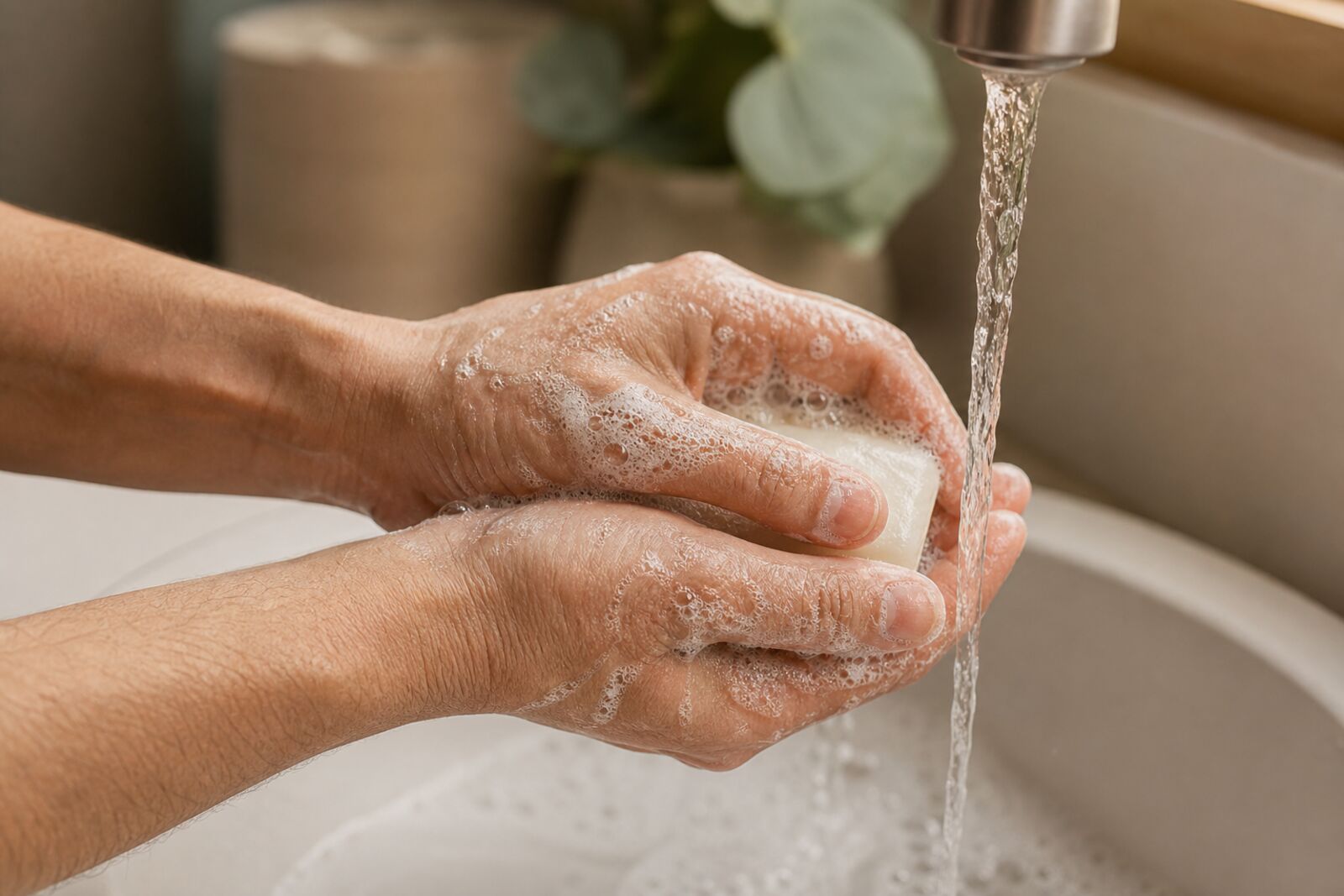
The mechanism was the giveaway all along. Soap doesn't work mainly by killing germs. Its surfactant molecules pry microbes, oil, and grime off your skin, and 20 seconds of rubbing under warm water sends the whole mess down the drain, dead or alive. "Antibacterial" was an answer to a question soap had already solved by removal, which is why no one could measure an upgrade. There was nothing left to upgrade. The great handwashing revival of 2020 ran on exactly two technologies, plain soap and alcohol, and nobody missed triclosan for a second.
That pattern, inventing a premium layer of protection and never proving it, did not retire in 2017. Its cousins live on in silver-infused socks, antimicrobial phone cases, and self-sanitizing everything. The defense is the same each time: ask what the plain version fails to do. With soap the answer was, and remains, nothing. Buy whatever soap makes you willing to wash for the full 20 seconds. A store-brand refill jug works. So does something nicer like Dr. Bronner's, which is fine soap at a premium price with a philosophy lecture printed on the label.
Bottom line
Plain soap, warm water, 20 seconds. That's the whole technology, and the FDA effectively certified it in 2016 by banning the alternatives that couldn't beat it. Keep alcohol sanitizer for sinkless moments, and read "antibacterial" on any wash-off product as a marketing fee, not a feature.