The short version
- PFOA, the chemical that earned nonstick its reputation, was gone from major cookware manufacturing by about 2013. If your pan is newer than that, the thing you're afraid of isn't in it.
- The one documented way a nonstick pan makes a person sick is overheating. Past roughly 500°F the coating breaks down and the fumes cause a transient flu. For pet birds it's lethal in minutes.
- Flakes from a scratched pan are treated as inert by poison centers. Replace a flaking pan because it's a bad pan now, not because it's poisoning you.
- "Ceramic" pans are proprietary sol-gel coatings that lose their slickness faster than PTFE does. A premium price for "non-toxic" buys marketing, not longevity.
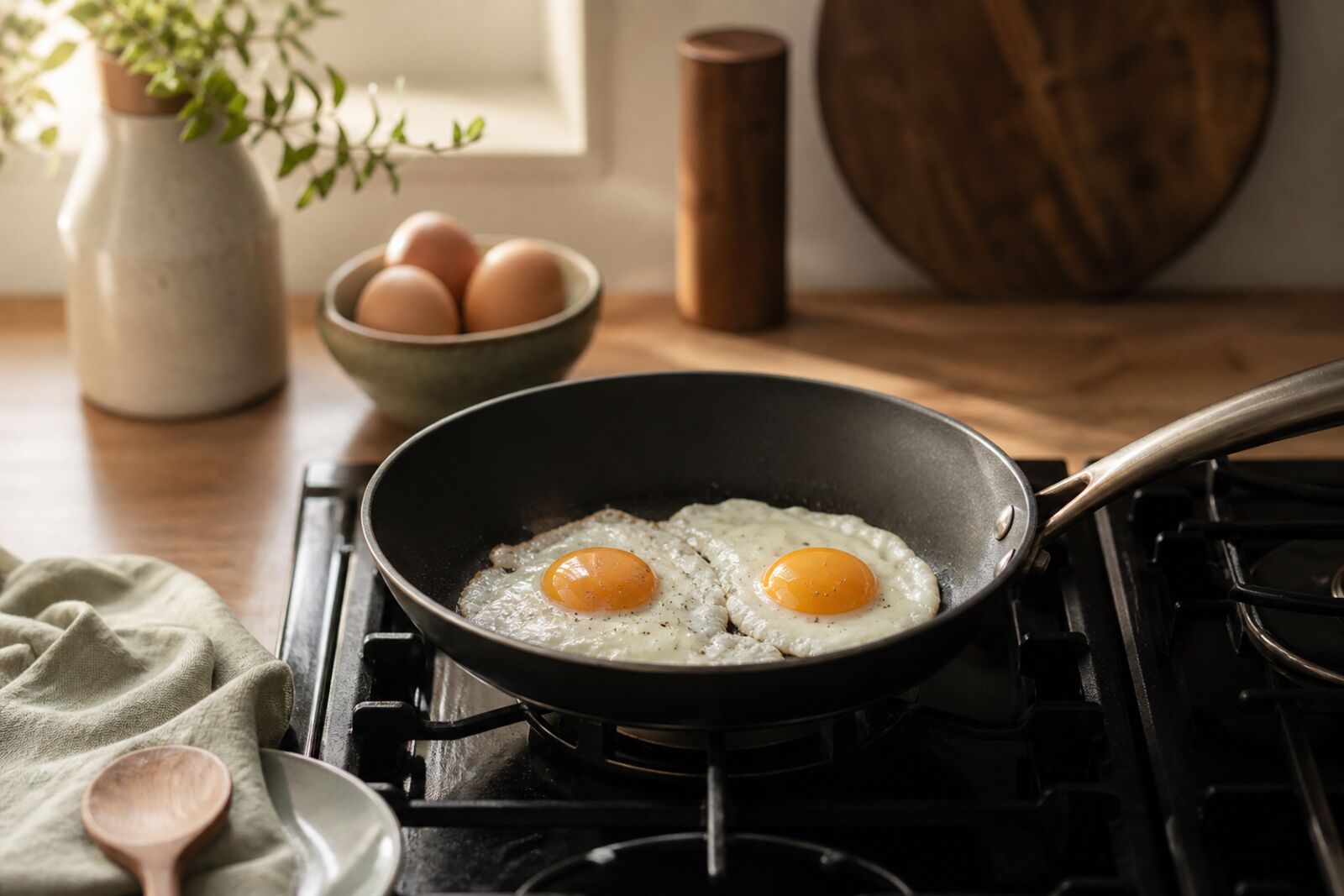
An empty nonstick skillet on a hot burner clears 500°F in two or three minutes. That, and not the scratch across the bottom of your egg pan, is the part of nonstick cooking with a documented path to making a person sick.
Most arguments about Teflon fall apart the moment you separate three questions that keep getting jammed together: what the coating is made of, what it does when it gets too hot, and what happens when it wears out. Each one has a different answer, and only one of them should change your behavior.
The chemical everyone is still angry about left in 2013
PFOA is the one that earned the fear, and it deserved it. It was a processing aid used in the manufacture of PTFE, the fluoropolymer sold as Teflon, and it's persistent, bioaccumulative, and genuinely harmful. The C8 Science Panel, set up under a settlement with DuPont to study the community around its Parkersburg, West Virginia plant, found probable links between PFOA exposure and kidney cancer, testicular cancer, thyroid disease, ulcerative colitis, preeclampsia, and high cholesterol. None of that was invented by activists.
Then it ended. In 2006 the EPA launched the PFOA Stewardship Program with the eight largest fluoropolymer manufacturers, asking for a 95 percent reduction in PFOA emissions and product content by 2010 and complete elimination by 2015. All eight reported meeting the targets, and the major nonstick coatings have been PFOA-free since roughly 2013. A pan you bought in the last decade does not contain it.
What "PFOA-free" does not mean is PFAS-free. PTFE is a fluoropolymer, and by the broad definition of PFAS it counts. The distinction that matters is size and mobility. PFOA is a small molecule that gets into blood and stays there for years. PTFE is an enormous, insoluble polymer that toxicology treats roughly the way it treats a rock. Any brand selling you cookware by blurring those two is counting on you not knowing the difference.
The unresolved fight is upstream. Fluoropolymer plants still release PFAS into air and water, and the replacement chemistries that came after PFOA are now getting the scrutiny PFOA got. That's a real regulatory problem and worth caring about as a citizen. It is a different problem from your skillet.
Heat is the actual mechanism
PTFE holds up fine through anything resembling normal cooking. Push it past about 500°F and it begins to degrade, with most sources putting meaningful breakdown somewhere between 500 and 536°F. The fumes cause polymer fume fever, known everywhere as Teflon flu: chills, headache, fever, chest tightness, cough. Symptoms show up four to eight hours after exposure and clear in a day or two.
It's real, and it's uncommon. America's Poison Centers logged 267 suspected cases in 2023, the highest count since 2000, out of more than 3,600 recorded over two decades of tracking. Some of those are industrial exposures, not home cooks. As household hazards go, this one sits closer to "ruined weekend" than "chemical catastrophe."
Birds are the brutal exception. Their respiratory systems are far more efficient at pulling gas out of air than ours, and fumes that give a person a headache can kill a parrot in minutes. It's documented well enough that avian vets treat it as a standing warning. If you keep birds, either the PTFE pans go or the birds live nowhere near the kitchen. There isn't a moderate version of that rule.
For everyone else the fix is boring and free. Never preheat a nonstick pan empty. Keep it at medium or below. Run the vent hood. Use something else when you want a hard sear, which you should be doing anyway, because nonstick is bad at searing. Nonstick is an eggs, fish, pancakes, and crepes tool. Treat it like one and the temperature question never comes up.
Scratches are the least interesting part of this
Poison centers treat swallowed PTFE as inert. The Missouri Poison Center's guidance is blunt about it: swallowed pieces travel through the gut and come out intact. There's no absorption pathway and nothing to accumulate.
You may have seen a scarier number. A 2022 paper in Science of the Total Environment, from researchers at Newcastle University and Flinders University in Australia, used Raman imaging to estimate that a single crack in a Teflon coating can shed roughly 9,100 plastic particles, and a badly broken coating as many as 2.3 million. Those figures are real and they traveled fast. What the study did not do, and did not claim to do, is demonstrate harm. It counted particles. "Millions" is an impressive-sounding word that tells you nothing about whether a dose matters.
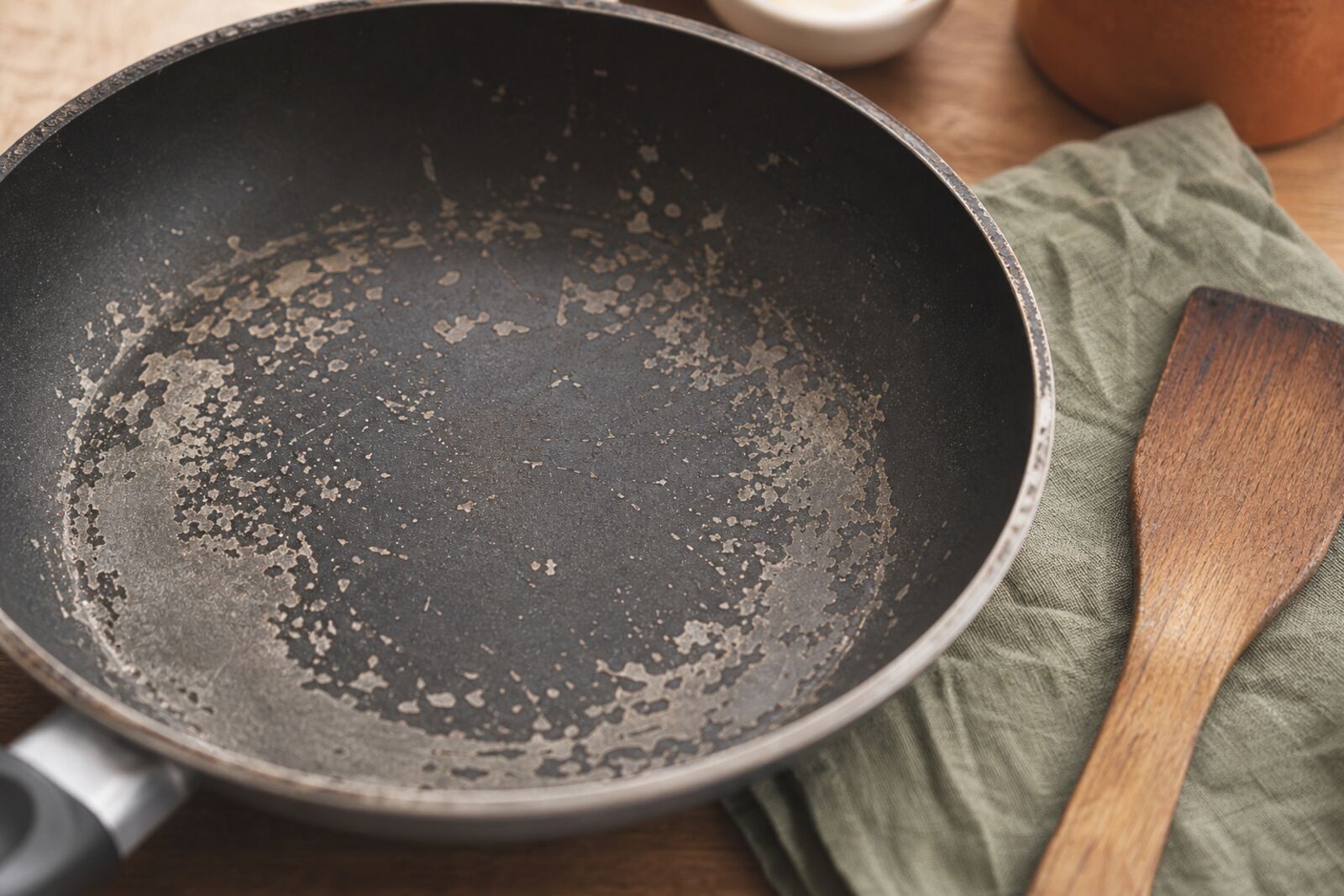
Replace a flaking pan anyway. Not because the flakes are poison, but because a pan shedding its coating has stopped doing the single job you bought it for, and you no longer know what's exposed underneath.
"Ceramic" pans are not ceramic, and they don't last
The non-toxic cookware aisle is mostly one technology in a nice sweater. GreenPan, Caraway, Our Place, and most of their competitors use a sol-gel coating: a silica-based liquid that cures into a hard, slick film. It looks ceramic and feels ceramic. It is not fired clay. The formulations are proprietary, which is exactly where the radical-transparency positioning of these brands tends to stop.
The advantage is genuine. No fluoropolymer, no PFAS, no polymer fume fever, and a higher heat tolerance. The disadvantage is durability, and it's steep. A 2024 assessment of nonstick coatings found PTFE outperforming sol-gel ceramics by a wide margin on release performance across repeated cooking cycles. In a real kitchen that shows up as a pan that goes gummy and sticky within a year or two, at which point you buy another one. A pan you replace every eighteen months at boutique prices is not the environmental story the packaging is telling.
Three honest takes. GreenPan created this category and its Thermolon coating is the most established of the bunch, but it still dulls with time like every other sol-gel surface. Caraway makes the prettiest version and charges accordingly, and you are paying substantially for the colorway, not for a chemically different coating. The Our Place Always Pan is a clever piece of design for a small kitchen with one drawer, and it does six jobs acceptably rather than one job brilliantly.
Worth remembering that "non-toxic" is not a regulated term. Nobody has to prove anything to print it.
How the four options actually compare
| Surface | What it really is | Documented risk | Realistic lifespan |
|---|---|---|---|
| PTFE nonstick | Fluoropolymer film, PFOA-free since about 2013 | Fumes above roughly 500°F; lethal to birds | Three to five years, less with metal utensils |
| Sol-gel "ceramic" | Proprietary silica-based coating, not clay | None established at cooking temperatures | One to two years before it stops releasing |
| Cast iron and carbon steel | Bare iron plus polymerized oil seasoning | Adds dietary iron, which matters if you have hemochromatosis | Decades, arguably forever |
| Stainless steel | Iron alloyed with chromium and usually nickel | Trace nickel and chromium leaching, mostly into acidic foods | Decades |
The two-pan answer
Nearly everyone who cooks at home is served by one cheap nonstick pan reserved for eggs and delicate fish, plus one heavy pan that can take real heat. The nonstick is a consumable, so buy it accordingly and don't get emotionally attached. The heavy pan is a lifetime object, so buy it once.
If PTFE bothers you on principle, the substitution is not a $150 ceramic skillet. It's cast iron for under $40, or carbon steel if you want something lighter with the same physics. Both get slicker with use instead of worse, which no coated pan on earth can claim.
Bottom line
Keep an undamaged PTFE pan for eggs and fish, cook in it at medium or below, and never preheat it empty. Replace it when the coating starts to flake, and buy an inexpensive one, because every nonstick pan is a consumable no matter what it cost. Skip the premium "non-toxic" cookware sets entirely unless you love how they look, because a cast iron skillet solves the same problem for a fraction of the price and lasts fifty times longer.