The short version
- Fiberglass flame barriers are legal and common in budget foam mattresses. The trouble starts when a zippered cover comes off, so never unzip one.
- GOTS and GOLS are the certifications worth paying for. CertiPUR-US covers the foam only, and "eco", "green", and "natural" cover nothing.
- The new-mattress smell is real VOC off-gassing, and it mostly fades within days. Air the room out and don't panic.
- On a budget, an innerspring with a wool flame barrier and a cover that stays zipped gets you most of the way there.
The unzipped cover that started it
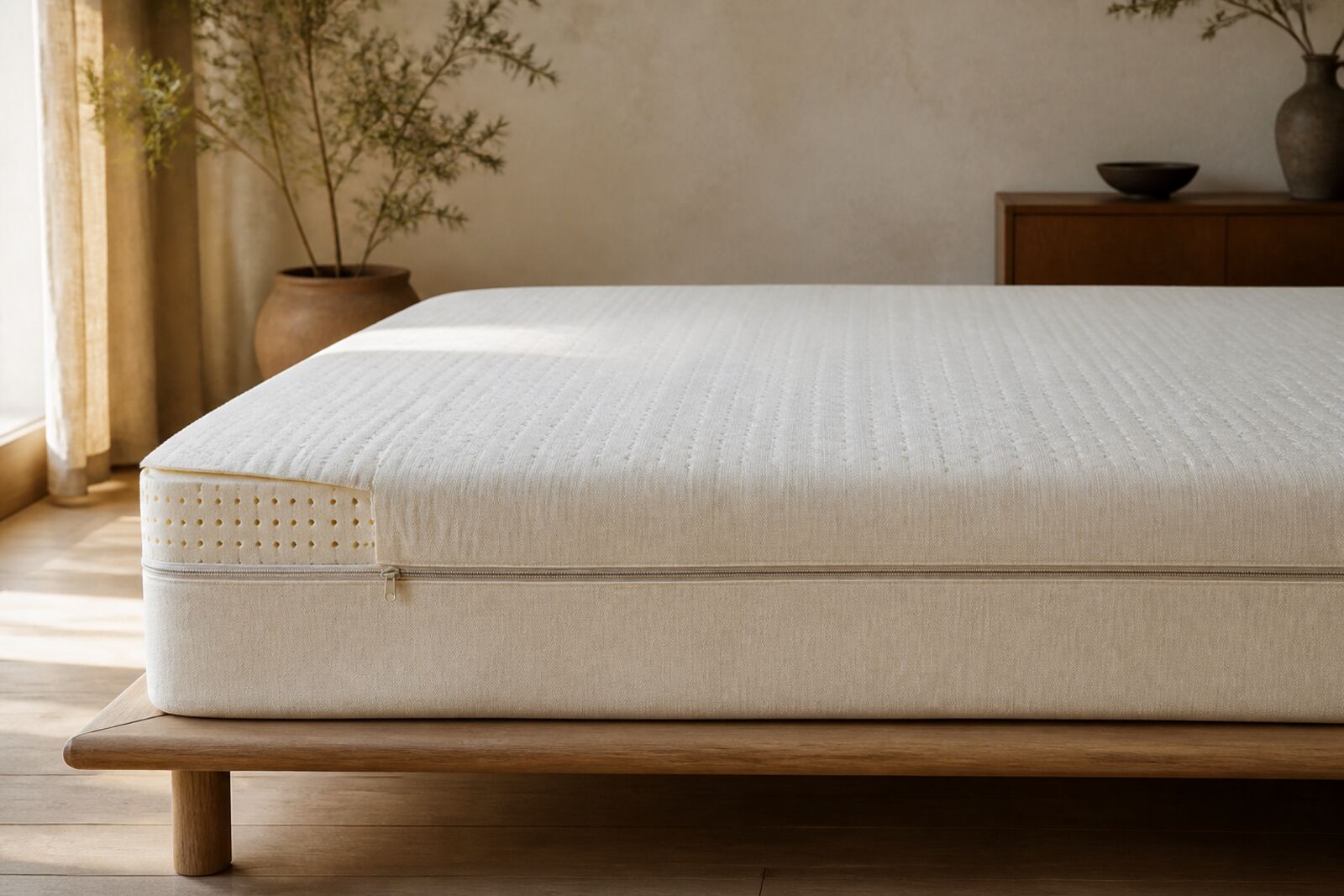
In the summer of 2019, an Illinois family bought a Zinus memory foam mattress at Walmart for their child. At some point they unzipped the outer cover, the kind of zipper that looks like an invitation to wash the thing. According to the class action they filed in March 2020, what came out was fiberglass: fine glass fibers that spread through the house, worked into clothes and carpet, and cost more than $20,000 in professional remediation. A CBS affiliate had already aired a segment on the family, "Hidden Hazards", a month before the suit.
They weren't alone. A second class action, filed in California in 2022, made the same claim about the Zinus Green Tea mattress, at the time one of the best-selling mattresses on Amazon: unzip the cover and the fiberglass flame barrier underneath can shed into your home. That case ended quietly. The parties told the court they'd settled in April 2023, and the suit was dismissed that August with the terms kept private and nothing admitted.
Here's the part worth sitting with: putting fiberglass in a mattress wasn't, and isn't, illegal.
Why there's glass in a bed at all
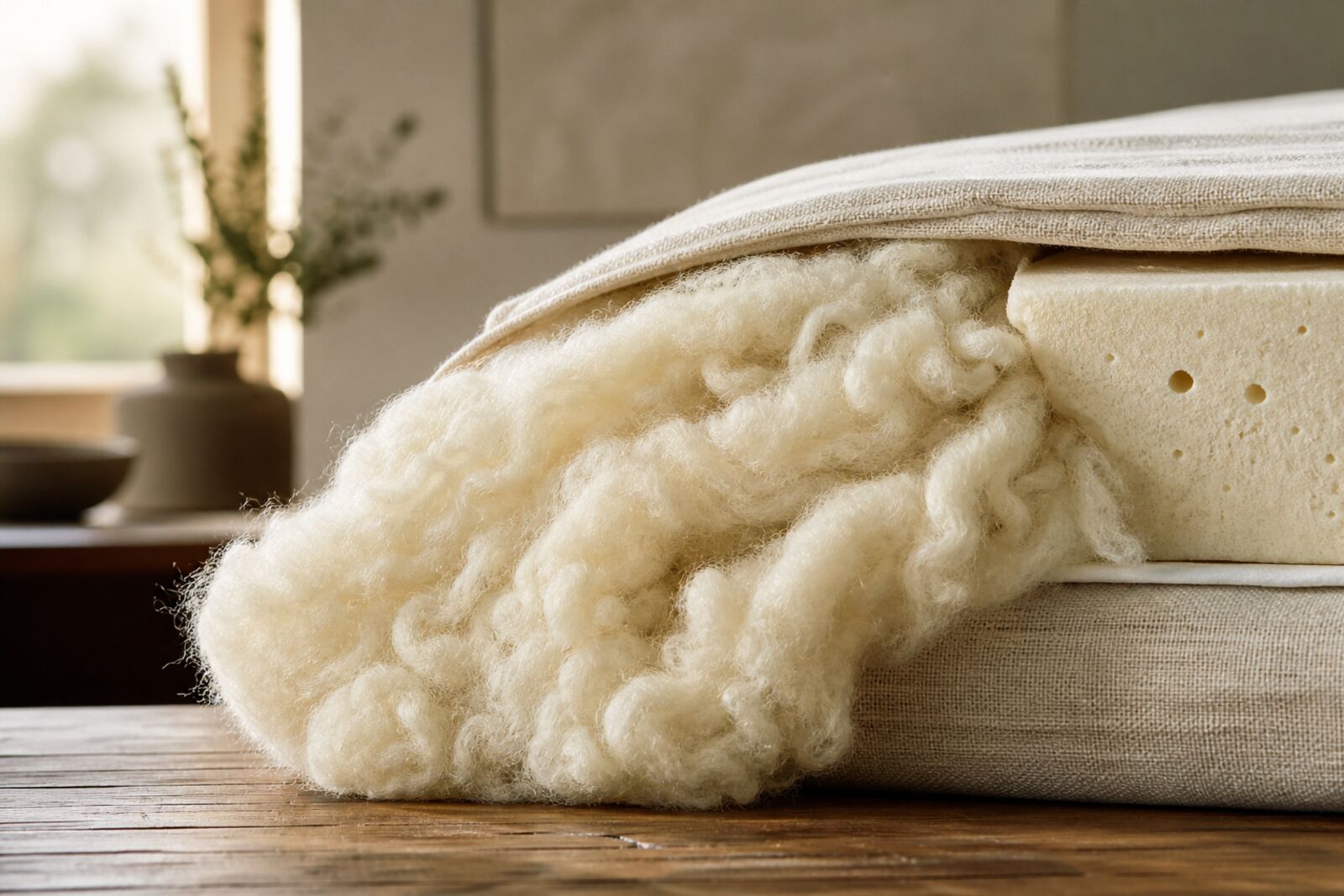
Since 2007, every mattress sold in the US has had to pass a federal open flame test. Manufacturers meet it with a flame barrier, an inner sock between the foam and the cover. Wool works. Rayon blended with silica works. And fiberglass works for pennies, which is why it became the default in cheap foam beds.
Contained fiberglass isn't the problem. It sits inside the mattress doing its one job, and a bed you never open isn't dusting your room with glass. The problem is the combination the lawsuits described: a fiberglass sock under a cover with a zipper on it, sold to people who reasonably assume zippers exist to be unzipped. People wash covers. That's the entire failure mode.
So "fiberglass-free" became the most meaningful two words in bedding. Not because fiberglass is uniquely poisonous (it's an irritant, not a toxin in the arsenic sense), but because an escape genuinely wrecks a home and irritates skin, eyes, and airways, and remediation bills run to five figures. If a mattress has a zippered cover, find out what's under it before you buy. And whatever you own now, leave the zipper alone.
The certification decoder
Mattress marketing runs on adjectives. Certifications are the only words on the page with definitions and auditors behind them, and they're not interchangeable.
| Label | What it actually covers |
|---|---|
| GOTS | The whole textile product. At least 95% certified organic fiber for the "organic" grade (70% for "made with organic"), plus limits on processing chemicals and dyes. The strongest whole-mattress signal. |
| GOLS | The latex core: at least 95% certified organic latex. Pair it with GOTS, because it says nothing about the fabric around it. |
| GREENGUARD Gold | Emissions only. The finished product sits in a chamber and its VOC output must come in under strict limits. A real signal, but it doesn't tell you what's inside. |
| OEKO-TEX Standard 100 | Materials tested against a long list of restricted substances. Reassuring, but "tested for listed substances" is not "organic", and it's not a flame barrier disclosure. |
| CertiPUR-US | The polyurethane foam only: no PBDE-type flame retardants, formaldehyde, certain phthalates, or heavy metals in the foam, plus low foam VOCs. Created by the foam industry and carried by nearly every foam brand. |
| "Eco", "green", "natural" | Nothing. No definition, no threshold, no auditor. |
CertiPUR-US deserves one extra sentence, because brands lean on it hardest. It certifies a component, not the bed. It says nothing about the flame barrier, the adhesives, or the cover, which means a mattress can be CertiPUR-US certified and still wrap its foam in fiberglass. The program is fine for what it is. The way it gets marketed, as a whole-mattress health seal, is not.
The smell is real, the panic is optional
New mattresses, especially foam ones shipped compressed in a box, off-gas VOCs. That new-mattress smell isn't your imagination, and it isn't nothing. It's also, for the large majority of people, a short-lived nuisance: strongest the first day or two, mostly gone within a week. Unbox the thing in a room with a window open, let it breathe before you make the bed, and give it a few nights if you're sensitive or pregnant. Detectable is not the same as dangerous, and a smell that fades on schedule is transient off-gassing behaving exactly as expected.
What we'd actually buy
If the budget stretches, the two brands that treat certification as a design constraint rather than a sticker are Avocado and Naturepedic. Avocado's flagship Green mattress is GOTS certified, uses GOLS certified latex with a wool flame barrier, and lists at $2,099 for a queen. It goes on sale constantly, but it's still a lot of money, it's heavy, and the springy latex feel isn't for everyone. Naturepedic runs a fully certified organic line and is especially strong on kids' mattresses; expect roughly $2,000 to $3,000 for most queens.
The budget path is less glamorous and works fine: a basic innerspring from any maker that will tell you, in writing, what the flame barrier is made of. Wool and rayon-silica barriers show up in beds well under $1,000. Read the law tag, email support, and ask the question in six words: what is the flame barrier material? Treat a non-answer as an answer. Then, whatever you buy, keep the cover zipped for the life of the mattress and spot-clean instead of stripping it.
Bottom line
Spend for GOTS and GOLS if you can; Avocado and Naturepedic have earned the premium. If you can't, buy an innerspring whose maker confirms a wool or rayon-silica flame barrier in writing, and never unzip any mattress cover. Pay nothing extra for "eco", "green", or "natural".