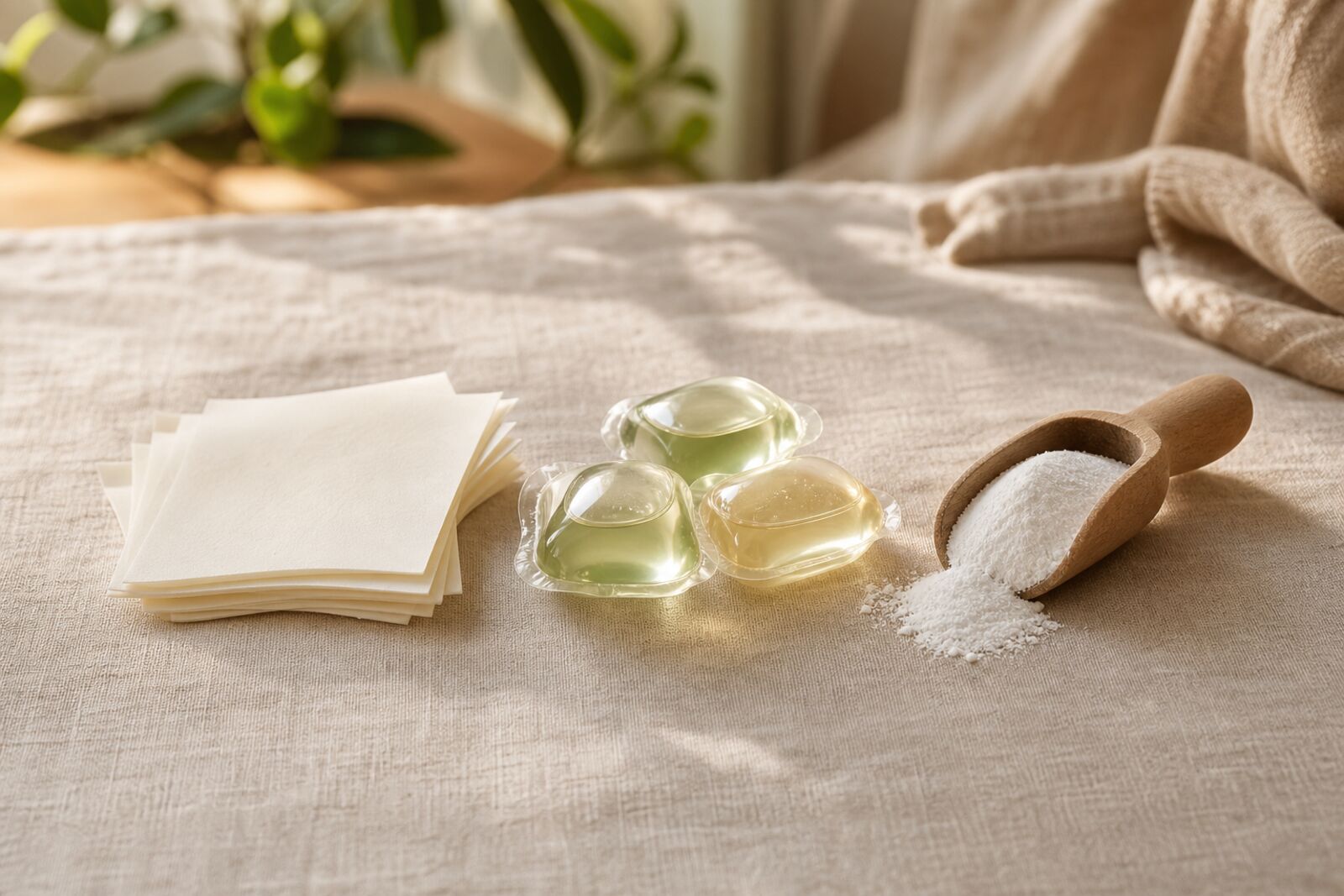
The short version
- Sheets and pods are both built on polyvinyl alcohol (PVA) film. It dissolves in water, but dissolving is not the same as disappearing.
- Whether PVA fully biodegrades in real wastewater plants is genuinely contested. The loudest study was funded by Blueland, and the loudest rebuttals come from the detergent industry. The EPA sided with the industry in 2023.
- The part nobody disputes: in Consumer Reports' testing, detergent sheets cleaned worse than the lowest-scoring liquids.
- A fragrance-free liquid or powder, correctly dosed, wins on cleaning, cost, and peace of mind. Sheets are a convenience choice, not a health one.
The film both sides are fighting over
Detergent sheets had one of the great marketing runs of the decade. A slim cardboard envelope instead of a 100-ounce jug, the words "plastic-free" in a friendly font, and a genuinely nice unboxing moment for a laundry product. The catch is in the sheet itself: most of them are detergent dried into a matrix of polyvinyl alcohol, a synthetic, petroleum-derived polymer you'll see abbreviated as PVA or PVOH. It's the same class of material as the shiny film on a laundry pod.
Drop it in water and it dissolves. Everyone agrees on that much. The argument is about what happens next: whether the dissolved polymer actually gets eaten by microbes at the wastewater plant, or mostly just flows through and out the other side. Sugar dissolves too. So does salt. Solubility tells you nothing about biodegradation.
The Blueland study, and its asterisk
In 2021, Arizona State University researchers Charles Rolsky and Varun Kelkar published a paper in the International Journal of Environmental Research and Public Health estimating that roughly three quarters of the PVA entering US wastewater treatment doesn't fully biodegrade there, leaving the rest to move on into waterways, sludge, and soil. It was a modeling study built on existing literature, not new field measurements, and it was partly funded by Blueland, a company that sells detergent tablets and built its whole brand on being anti-plastic.
That funding doesn't make the paper wrong. It does mean you should hold it the way you'd hold a study on bacon funded by the pork board. Tide's parent company published a technical review calling the study flawed. Of course it did; Tide sells a lot of pods. Both of those sentences can be true at once, which is exactly what makes this debate so annoying to referee.
The EPA looked at it and said no
Blueland and the Plastic Pollution Coalition took the argument to regulators, petitioning the EPA in January 2023 to require health and environmental testing of PVA and to pull it from the agency's Safer Chemical Ingredients List in the meantime. In April 2023 the EPA denied the petition, writing that it failed to provide reliable evidence that detergent-grade PVA poses the harms claimed, and reaffirming the polymer's place in its Safer Choice program.
The American Cleaning Institute, the detergent industry's trade group, says decades of data show this specific grade of PVA biodegrades under normal treatment conditions, and it has not been gentle about saying so; it has called Blueland's campaign deliberate deception. Blueland's response, roughly: nobody has disputed that PVA is a petroleum-based polymer, and the biodegradation data doesn't cover real end-of-life conditions.
So where does that leave you? With a genuinely unsettled question and two motivated parties. Blueland sells the competing product. The ACI represents the companies that sell pods. The EPA is the closest thing to a neutral referee in the room, and it sided with the status quo, while environmental groups think the agency set the evidence bar conveniently high. We can't settle the chemistry from here, and we won't pretend to. What we can tell you is that everything else about sheets is much less flattering.
The part nobody disputes: sheets clean worse
Consumer Reports has tested detergent sheets and declined to recommend a single one. Its longtime laundry tester, Rich Handel, put it plainly: as a group, the sheets scored below the lowest-performing liquids and pods in CR's ratings. Wirecutter's testing landed in the same place, with sheets doing especially badly in cold water, which is the water most of us are told to use.
If your laundry is lightly worn office clothes, you may honestly never notice. If you have kids, play sports, or run cold cycles to save energy, you will. Earth Breeze, the biggest sheet brand, is a perfectly decent version of the thing it is: a light-duty detergent in a very shippable format. Just be clear that the format is the product.
Fragrance is the quieter problem
While the internet argues about the film, the ingredient with the clearer track record of causing actual human misery sails by: perfume. On a US label, the single word "fragrance" can legally stand in for a long list of undisclosed components, a trade-secret carve-out much older than any of these brands. Fragrance mixes are among the most common causes of skin allergy, and scented laundry products sit against your skin all day, every day.
The fix costs nothing: buy the free-and-clear version of whatever you already like. Tide Free & Gentle and all-free clear are the boring standbys, both easy to find and regularly near the top of CR's ratings for sensitive-skin formulas. "Free and clear" is one of the few label phrases that means something concrete: no added dyes, no added fragrance.
You're probably using twice as much as you need
Here's the cheapest upgrade in this entire article. Detergent caps are measuring devices designed by the people who profit when you overpour, and the fill lines are famously easy to blow past. Modern high-efficiency machines need a surprisingly small dose, often around two tablespoons of a concentrated liquid for a normal load. Overdosing doesn't get clothes cleaner; it leaves residue in fabric, feeds mildew in the machine, and can force extra rinse cycles.
This, quietly, is the best honest argument for pods and sheets: one unit is one dose, and nobody can freehand it. If overdosing is your household's vice, a pod fixes it. So does a permanent marker line on the cap, for free.
Bottom line
A fragrance-free liquid or powder, dosed properly, is the boring winner: it cleans best, costs least, and sidesteps the PVA argument entirely. Sheets are a storage and shipping convenience, not a health upgrade, and they clean worse than almost everything else on the shelf. If plastic is what worries you, powder in a cardboard box has been sitting there the whole time.