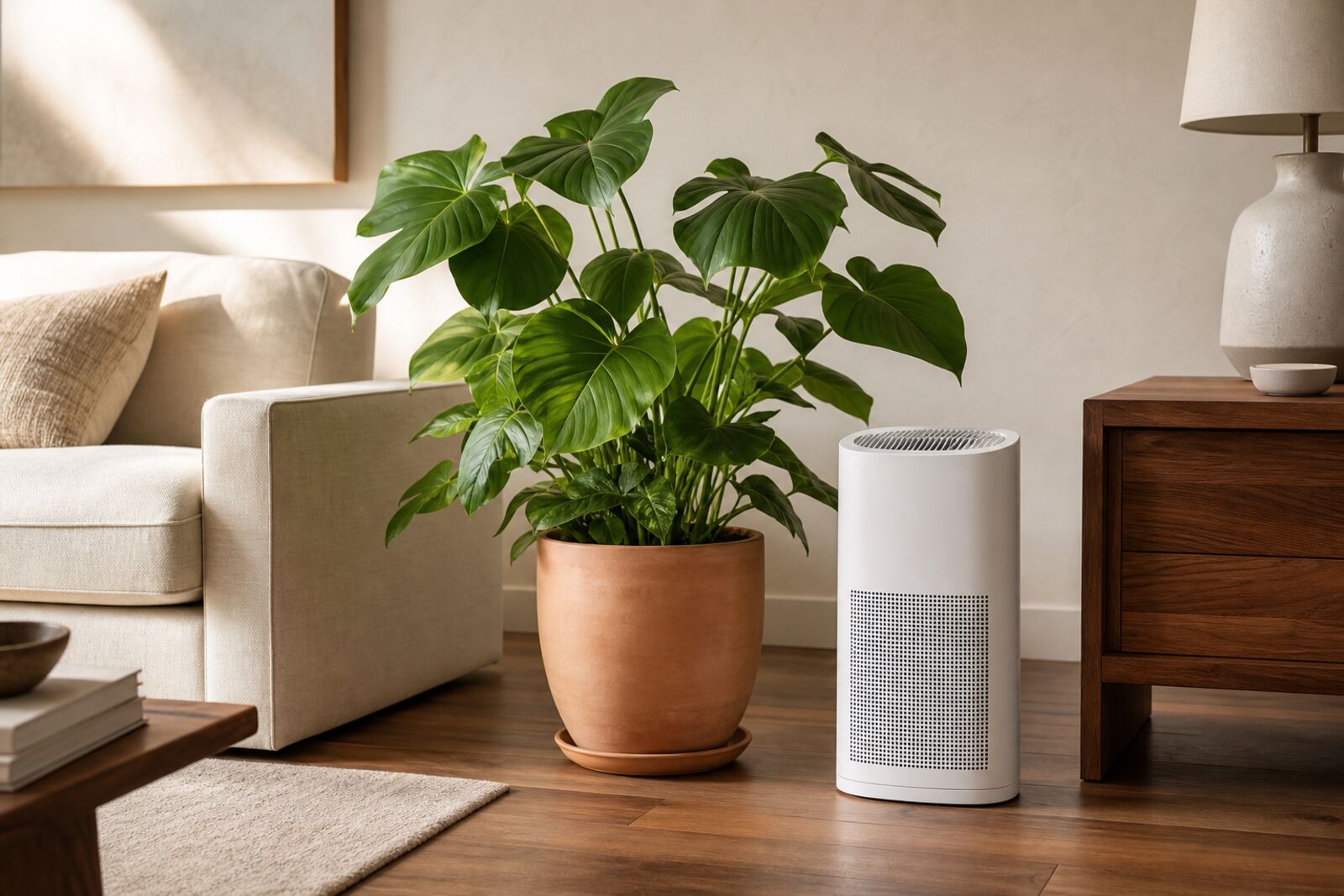
The short version
- The 1989 NASA plant study was run in small sealed chambers. A 2019 Drexel analysis found you'd need 10 to 1,000 plants per square meter to match what ordinary ventilation already does.
- The real levers, in order: ventilation, a HEPA purifier sized to the room by CADR, and running the range hood when you cook.
- Radon is the unglamorous one that actually kills. A test kit costs less than $30.
- Keep the plants. They're good for you in ways that have nothing to do with formaldehyde.
What NASA actually found in 1989
The pothos on your shelf is doing several nice things for you. Scrubbing benzene out of your living room air is not one of them, and the study everyone cites never claimed your living room.
In 1989, NASA researchers put houseplants in small sealed chambers, injected pollutants like formaldehyde and benzene, and measured what the plants (mostly their potting soil microbes, in fact) removed. In a sealed box, they removed plenty. NASA was thinking about space stations, which are, famously, sealed boxes. Your house is not. It constantly exchanges air with the outdoors, through leaks, windows, and fans, and that exchange dilutes pollutants far faster than any reasonable number of plants absorbs them.
The math that ended the argument
In 2019, Drexel University researchers Bryan Cummings and Michael Waring reviewed a dozen studies of plant VOC removal, 196 experiments in all, and converted the results into the metric air purifiers use, clean air delivery rate. Published in the Journal of Exposure Science and Environmental Epidemiology, their analysis found the median plant cleans air so slowly that you'd need somewhere between 10 and 1,000 plants per square meter of floor space to rival the air exchange a building already gets. Per square meter. Your home would not be a home with plants in it; it would be a hedge you sleep inside.
The wellness industry kept selling "air-purifying plant" lists anyway, and still does. So here's the short list of things that measurably change the air you breathe, ranked roughly by payoff per dollar.
Ventilation is most of the answer
Indoor air is usually dirtier than outdoor air because homes generate pollution (cooking, cleaning, offgassing furniture, us) and then trap it. The fix is exchange. Open windows when weather and outdoor air allow, ideally two on opposite sides for cross-flow. Run the bathroom exhaust fan during and after showers, and actually use the kitchen hood, which we'll get to. On bad wildfire or high-pollution days, reverse the advice: close up and filter instead. A $100 to $200 air quality monitor can tell you which kind of day it is, but so can a free app and your nose.
While you're at it, subtract sources. Scented candles, incense, and plug-in air fresheners add particles or volatile organic compounds to your air and remove exactly nothing. An air "freshener" is a fragrance dispenser; the air isn't fresher afterward, it's just wearing perfume.
Buy filtration by the number, not the adjectives
A true HEPA purifier is the one gadget in this category that earns its plug. The spec that matters is CADR, clean air delivery rate, printed on the box. The standard sizing rule from AHAM, the appliance trade group that certifies CADR: the smoke CADR should be at least two thirds of the room's square footage, so a 300-square-foot bedroom wants a CADR of 200 or more. Oversizing is even better, since you can run it on the quiet low setting.
You don't need to spend much. The Coway AP-1512HH has been a reviewer favorite for over a decade and handles a large bedroom; its looks are best described as "appliance." The Levoit Core 300 is the budget pick for small rooms, with the caveat that replacement filters are where both brands quietly make their money, so price a year of filters before you buy anything. Skip ionizers and "plasma" modes, which can generate ozone, a lung irritant, to solve a problem HEPA already solved.
Your stove is a bigger polluter than your couch
Cooking is one of the top sources of fine particles in homes, gas or electric, and searing or frying can spike particle counts past what you'd see on a smoggy street. The fix ships with your kitchen: turn on the range hood every time, use the back burners where capture is better, and if your hood just recirculates through a grease screen, crack a window too.
Gas stoves add nitrogen dioxide, a respiratory irritant, which is what the 2023 shouting match was actually about. A December 2022 study by Gruenwald and colleagues attributed about 12.7% of current US childhood asthma to gas stove use, and the figure ran wild through the discourse. The criticism was fair: it was a statistical attribution built on decades-old meta-analysis data, with no new measurements in a single kitchen. But strip away the contested number and the defensible core remains: gas combustion makes NO2 indoors, NO2 is bad for developing lungs, and ventilation removes most of it. You don't need to rip out your range. You need to turn on the hood.
The cheap test that actually saves lives
Radon is a colorless, odorless radioactive gas that seeps into homes from the soil, and the EPA attributes roughly 21,000 US lung cancer deaths a year to it, making it the second leading cause of lung cancer after smoking. It doesn't care how many plants you own or how clean your counters are. A home test kit costs under $30 at any hardware store, and if your level comes back at or above 4 picocuries per liter, mitigation (typically a vent pipe and fan, a few hundred to a couple thousand dollars) fixes it durably. Every home below the third floor should test once. Most never have.
Last, humidity: keep it between 30 and 50 percent, the range the EPA recommends, which is low enough to starve mold and dust mites and high enough that your sinuses don't file a complaint. A $10 hygrometer tells you where you stand; a dehumidifier or a habit of running exhaust fans handles the rest.
Bottom line
Keep the plants because they make you happy, not because they filter anything. Spend the money where the measurements are: open windows on good days, a HEPA purifier with a CADR matched to the room, the range hood every time you cook, and a radon test this month. That short list beats a jungle.