
The short version
- Hormones have been illegal in chicken and pork production for decades. "No hormones added" on a chicken package is advertising a law, and USDA makes brands print the fine print admitting it.
- "Natural" is a claim about processing, not about how the animal lived. "Free-range" means a door to the outside exists.
- USDA withdrew its grass-fed standard in 2016, so the words alone are barely verified. The third-party seals are.
- Antibiotic claims have the widest gap between promise and proof: USDA's own 2023 sampling found residues in roughly one in five cattle from the "raised without antibiotics" market.
The chicken case is a wall of promises. All natural. Free-range. No hormones or steroids. Vegetarian fed. Farm raised, which is where chickens come from.
A handful of those claims are audited by someone with authority to pull a label. Several are defined loosely enough to describe almost any farm. And one of them is advertising something that has been federal law since before you were born.
Hormone-free chicken is a law wearing a price tag
Federal regulations prohibit the use of hormones in raising poultry and pigs. Not "discourage." Prohibit. Every chicken breast and pork chop in the United States is hormone-free, whether or not the package says so.
USDA knows the claim is misleading, which is why it requires anyone printing "no hormones added" on poultry or pork to attach a disclaimer stating that federal regulations prohibit the use of hormones. Look at the back of the package and you'll usually find it, set in the smallest type the printer could manage.
This is the purest example of the genre: a claim that is completely true, completely useless, and reliably worth a couple of dollars a pound at checkout.
Beef is the one exception, and there the claim is real
Cattle are different. Steroid implants have been legal in US beef production for decades and are widely used, so on beef, "no hormones administered" is a meaningful claim. Producers have to document it for the USDA's Food Safety and Inspection Service to approve the label.
That's the whole rule to remember. On beef, the hormone claim means something. On chicken, turkey, and pork, it means the company knows what you're afraid of.
"Natural" describes the package, not the farm
Under FSIS policy, "natural" means the product contains no artificial ingredients or added color and is only minimally processed, and the label has to carry a short statement explaining that.
Everything that word covers happens after slaughter. It says nothing about feed, antibiotics, space, outdoor access, or how the animal spent its life. A chicken raised in the most industrial barn in America, sold as a plain raw breast, qualifies as natural.
"Free-range" means a door exists
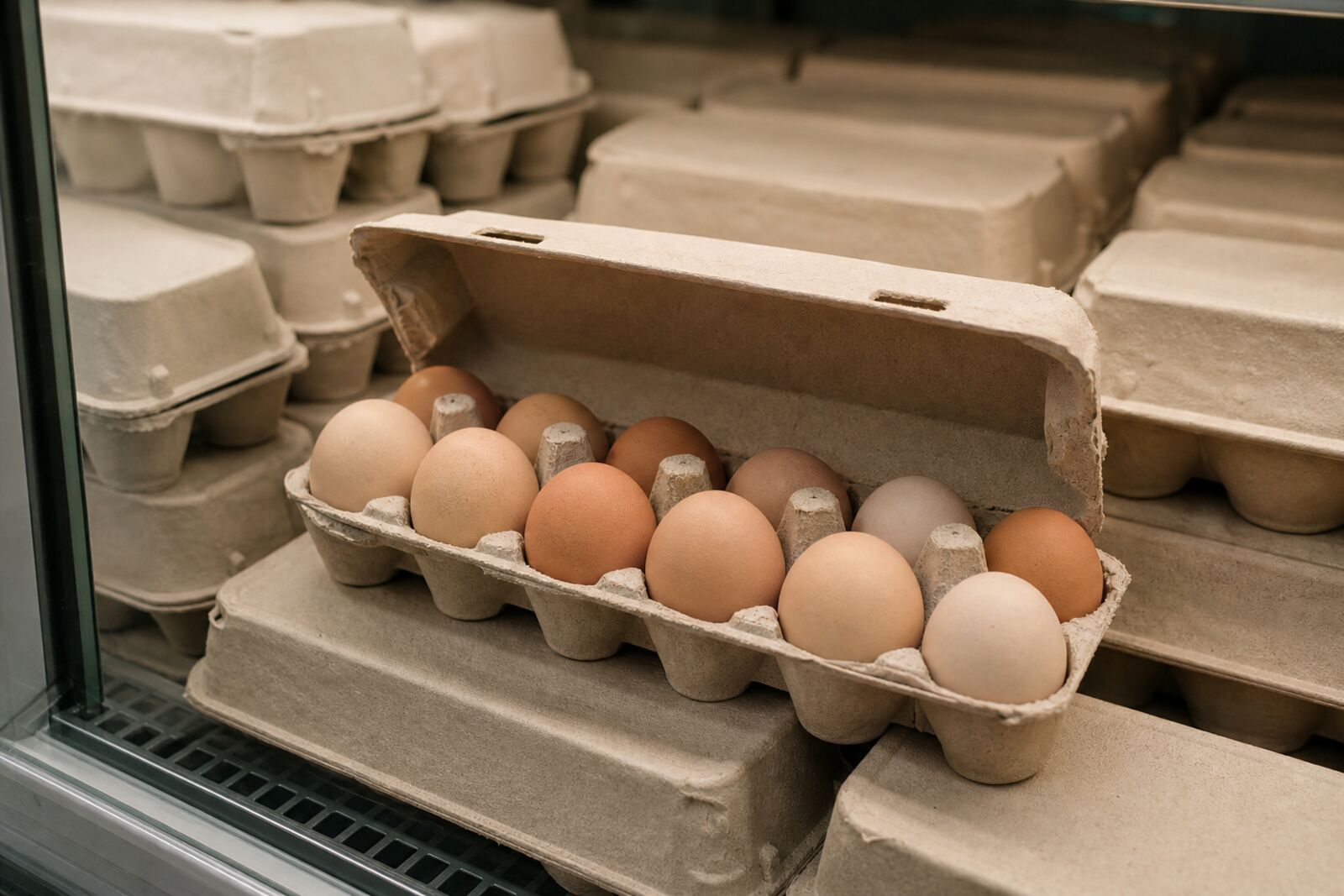
For poultry, the free-range claim requires that birds have access to the outdoors. That is essentially the entire standard.
The regulation doesn't specify how large the outdoor area must be, what's in it, how long the door stays open, or how many of the thousands of birds in the barn ever walk through it. Producers describe their own practice, FSIS reviews the description for plausibility, and two packages carrying the identical phrase can describe wildly different farms.
"Pasture-raised" implies much more, and has no federal definition at all. On eggs, "cage-free" does have a defined meaning under USDA grading, and what it means is uncaged inside a building. Not outside.
Grass-fed lost its referee in 2016
USDA's Agricultural Marketing Service withdrew its grass-fed marketing claim standard on January 12, 2016, concluding the claim sat outside its statutory authority. The words stayed on packages. The government definition behind them went away.
There's a second trap here even when the claim is honest. Nearly all beef cattle eat grass for most of their lives, then move to grain for finishing. "Grass-fed" without "grass-finished" can describe conventional beef accurately.
The fix is a seal. American Grassfed Association certification requires a lifetime diet of forage, no confinement, and no antibiotics or hormones, with audits behind it. A Greener World's Animal Welfare Approved program runs its own grass-fed certification. Those are the versions with a referee.
Antibiotics: the biggest gap between claim and verification
"Raised without antibiotics" and "no antibiotics ever" are claims that require FSIS pre-approval, with the producer supplying documentation. For years, that documentation was largely paperwork, with no routine testing to confirm any of it.
In 2023, FSIS and the Agricultural Research Service actually checked. They sampled liver and kidney tissue from 196 cattle at 84 slaughter establishments across 34 states, all destined for the raised-without-antibiotics market, and screened for more than 180 veterinary drugs. Roughly 20% of the samples came back with residues. Macrolide antibiotics were confirmed in 11% of the animals.
USDA sent letters and, in August 2024, released updated guidance recommending that companies making these claims run routine testing or obtain third-party certification that includes testing. Recommending. It's still not required.
So the phrase on the package is real, the enforcement behind it is thin, and the version with actual verification is a claim backed by a certifier who tests. Organic is the sturdiest of these, because antibiotic prohibition is part of an audited system rather than a standalone marketing line.
The seals that are worth the money
USDA Organic is a genuine, audited standard: certified organic feed, no antibiotics, no added hormones, outdoor access requirements, and an annual inspection by an accredited certifier. Fair criticisms exist, especially around how weakly outdoor access is enforced for poultry, but there is a real audit and a real certificate that can be revoked.
For animal welfare specifically, three programs have teeth: Animal Welfare Approved, Certified Humane from Humane Farm Animal Care, and Global Animal Partnership, whose tiered system runs from Step 1 through Step 5+ with every farm third-party audited. GAP's tiers are useful precisely because they're honest that Step 1 and Step 5 are not the same product.
| Claim | Regulated? | What it actually means |
|---|---|---|
| No hormones added (chicken, pork) | Yes, and required disclaimer | Nothing. Hormones are already illegal in poultry and pork. |
| No hormones administered (beef) | Yes, documented to FSIS | Real. Hormone implants are legal and common in beef, so this is a genuine difference. |
| Natural | Yes, but narrowly | No artificial ingredients, minimally processed. Says nothing about how the animal was raised. |
| Free-range (poultry) | Loosely | Access to the outdoors. No required size, quality, or duration. |
| Grass-fed | No federal standard since 2016 | Only as good as the certifier. Look for American Grassfed or Animal Welfare Approved. |
| No antibiotics ever | Pre-approved, weakly tested | USDA sampling found residues in about 20% of tested cattle from this market in 2023. |
| USDA Organic | Yes, annually audited | Organic feed, no antibiotics or added hormones, outdoor access, accredited inspection. |
| Certified Humane, AWA, GAP | Third-party audited | Real welfare standards with farm inspections. GAP's step levels tell you how much. |
None of this makes conventional meat unsafe to eat. It's a question of what you're being charged for, and whether anyone checked.
Bottom line
Pay for the audited seals (USDA Organic, Animal Welfare Approved, Certified Humane, Global Animal Partnership, American Grassfed) and ignore the vibes claims printed by the marketing department. Never pay a premium for hormone-free chicken or pork, because you already have it by law. And if antibiotic use is your reason for trading up, buy from a certifier that tests, not from a package that promises.