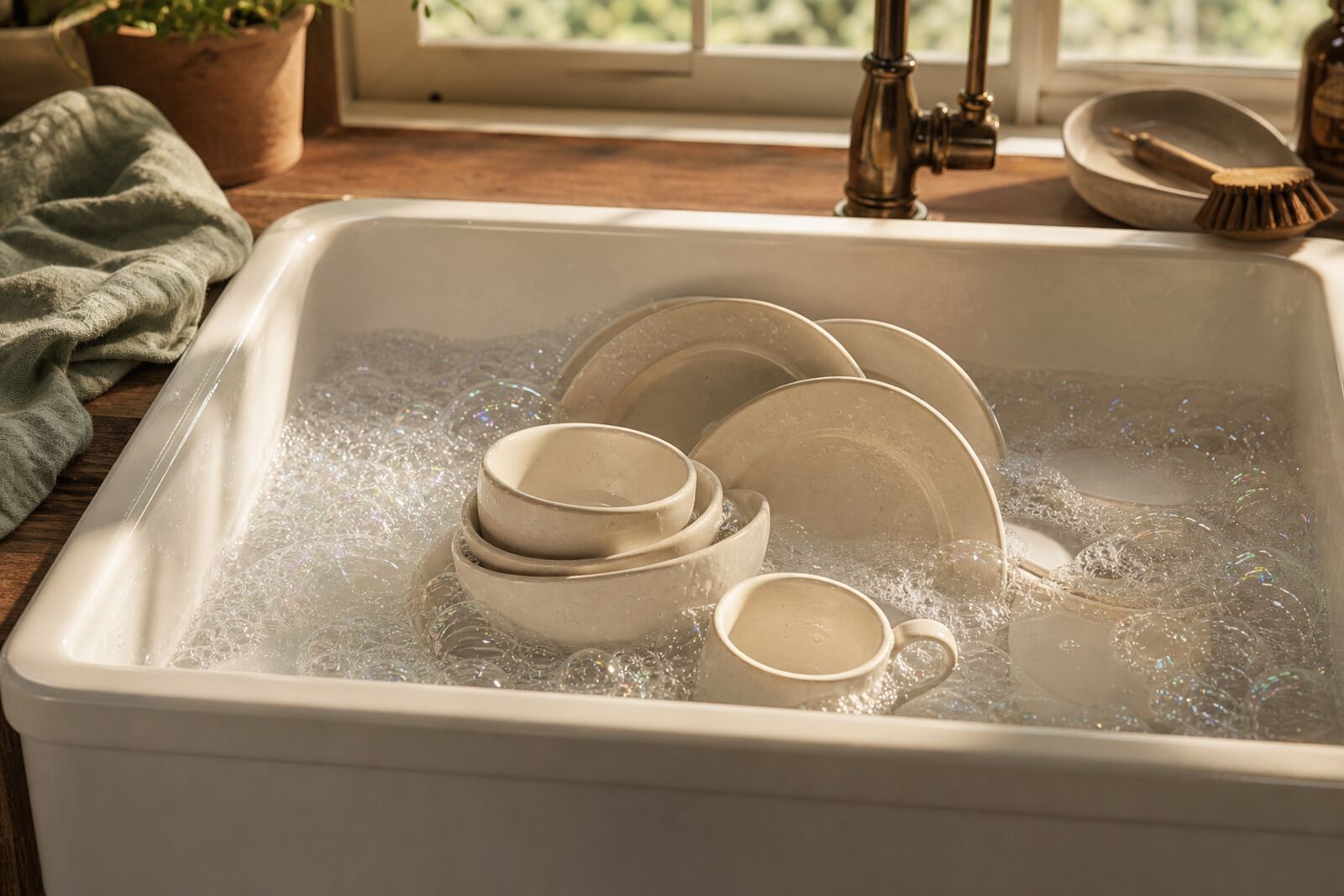
The short version
- Trace soap residue on rinsed dishes is real, tiny, and not worth your worry budget.
- New York forced the 1,4-dioxane contamination issue in 2022 and 2023, and big brands reformulated for the whole country.
- Fragrance is the one ingredient with a real case against it, and only if your skin or lungs complain.
- EPA Safer Choice is a label with actual teeth. Most other sink-aisle "non-toxic" claims are vibes.
Here's a sentence we don't get to write often on this site: this category is basically fine. Of everything in your kitchen with a chemical story attached, the dish soap bottle is the lowest-stakes item in the room. We'll walk through the real issues, because there are a couple, but we're telling you the ending up front so nobody reads this braced for doom.
The residue on your "clean" plate, measured honestly
Yes, a rinsed plate carries a trace film of surfactants, the grease-grabbing molecules that make soap work. With a decent rinse it's a vanishingly small amount, and dish surfactants are among the most-studied chemicals in consumer products precisely because regulators assume some of them end up ingested. At the doses involved, your body clears them without drama.
This is the place to say our favorite boring sentence: detectable is not dangerous. The fix for residue, if you want one, has been known since your great-grandmother's kitchen: rinse with running water for a few extra seconds. Free, done.
The dishwasher version of this worry is smaller still, because the machine meters its detergent and rinses with fresh hot water. If a glass ever tastes soapy, that's a rinsing or loading problem to fix for your palate's sake, not evidence you've been dosed.
The 1,4-dioxane story, already mostly fixed
The one legitimate contaminant story in this aisle is 1,4-dioxane. It's not an ingredient anyone adds; it forms as a byproduct when manufacturers process certain surfactants through ethoxylation, and the EPA classifies it as a likely human carcinogen at sufficient exposure. Traces of it showed up for years in detergents, shampoos, and dish soaps.
Then New York did something useful. The state capped 1,4-dioxane in household cleaning products at 2 parts per million at the end of 2022, tightening to 1 part per million a year later, the first limits of their kind in the country. Because no company wants to make a separate soap for one state, the big brands reformulated nationally. The practical upshot for you: the worst of this problem was regulated away while nobody was watching, which is how boring victories usually happen. If you'd rather skip ethoxylated surfactants entirely, castile soap contains none.
Fragrance is the actual decision point
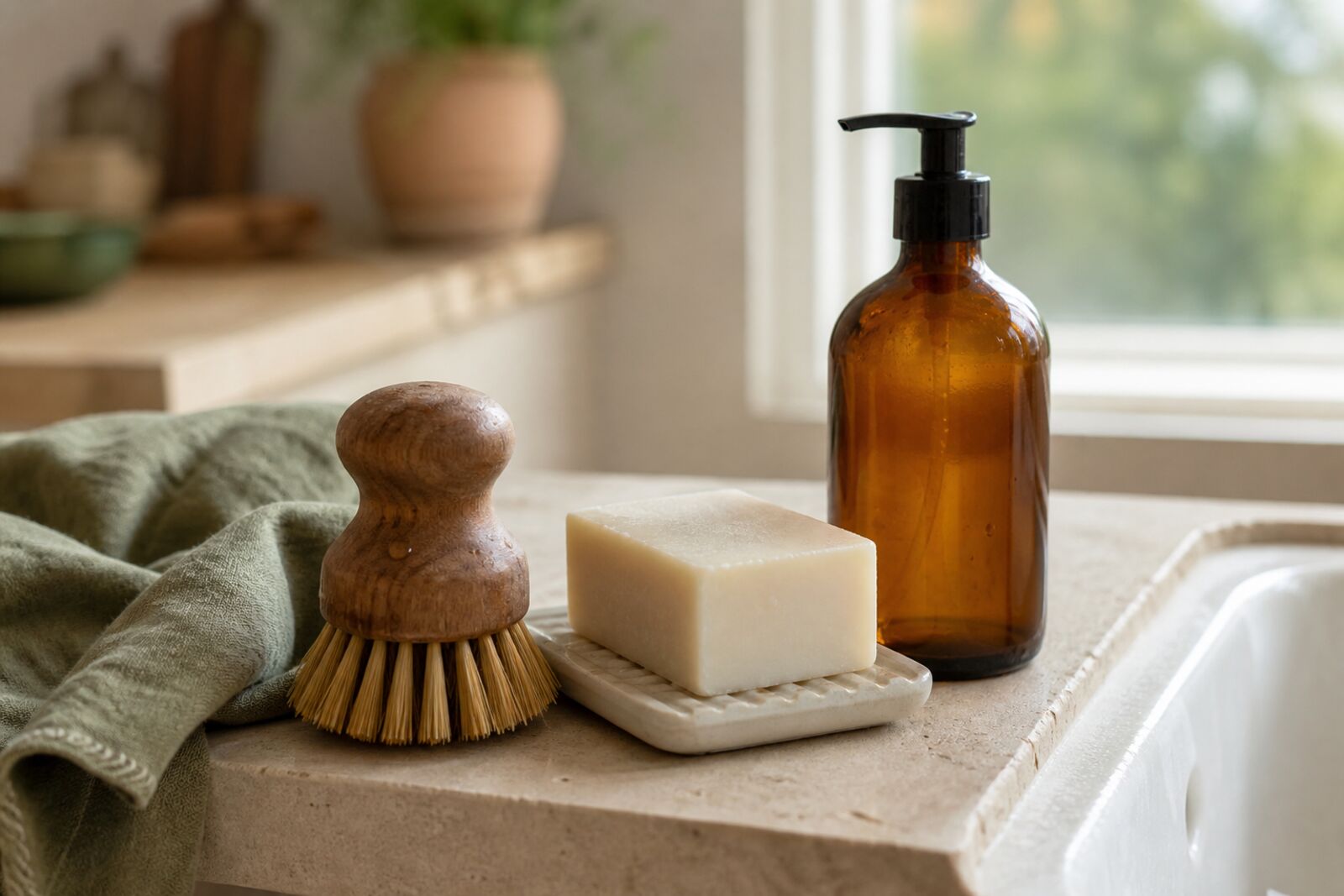
Here's the ingredient with a real case against it, and it's the one that smells like a meadow. The word "fragrance" on a label is legally a sealed box: it can stand in for a proprietary blend of many compounds that don't get listed individually. For most people this is a non-issue on dishes. But if you have eczema-prone hands (dishwashing is a classic trigger), fragrance allergies, or asthma that flares at the sink over hot water, fragrance is the single variable worth controlling, because you're both wearing it and breathing it twice a day.
The good news is that fragrance-free costs almost nothing in performance. Seventh Generation Free & Clear carries the EPA Safer Choice label and cleans like any mainstream soap, though it costs more than the store brand. Unscented castile soap, Dr. Bronner's being the classic, also does the job, with the honest caveat that in hard water it can leave a filmy mineral haze on glassware. And about that Safer Choice label: it's a real EPA program that reviews every ingredient in a formula against safety criteria, which makes it one of the few front-of-bottle claims in this aisle that isn't self-awarded.
What you can skip: paying double for "detox," "pure," or "clean" branding on a soap whose ingredient list matches the cheap one. Fear-based marketing loves this aisle precisely because the stakes are low and the margins are nice.
The antibacterial detour nobody needs to take
A quick word on "antibacterial" dish soap, since the label still floats around the aisle. The FDA's 2016 rule pulled triclosan and 18 other antiseptic ingredients from consumer wash products after manufacturers couldn't show they beat plain soap and water, and the industry has largely moved away from triclosan since. The modern "antibacterial" dish soaps use different active ingredients and market themselves for washing hands while you wash dishes. You don't need any of it. Plain surfactants plus scrubbing plus hot water is the whole food-safety mechanism, and it was never the soap's job to sterilize your plate anyway. Buy on price, fragrance, and how it treats your hands.
The rinse aid scare, with the dose attached
In late 2022, researchers at the Swiss Institute of Allergy and Asthma Research published a study in the Journal of Allergy and Clinical Immunology showing that rinse aid residue, and specifically a class of surfactants called alcohol ethoxylates, damaged the protective barrier of gut cells in lab models. Real study, real journal, and it traveled fast under headlines about dishwashers destroying your gut.
Now the context the headlines dropped. The damage happened in cell cultures and gut-on-a-chip models dosed directly with the residue. The researchers' sharpest concern was commercial dishwashers, the rapid-cycle machines in restaurants and cafeterias that can skip a fresh-water final rinse, leaving residue to dry in place. Home dishwashers rinse after the rinse aid stage. A dish of cells meeting concentrated surfactant is a hazard demonstration, not a measurement of what your intestines see after a normal home cycle, and the study's own authors framed it as a call for more research, not a verdict.
If it still nags at you, the fix is refreshingly cheap: rinse aid is optional. Skip it and your glasses come out with water spots, which is the entire penalty. That's a trade you're allowed to make in either direction without a second thought.
Bottom line
If fragrance bothers your skin or your lungs, buy a fragrance-free soap like Seventh Generation Free & Clear and be done. Everyone else can grab nearly any bottle on the shelf, skip the "detox" premium, and treat rinse aid as a spots-versus-none preference. Spend your worry budget elsewhere in the kitchen; this aisle has earned a pass.