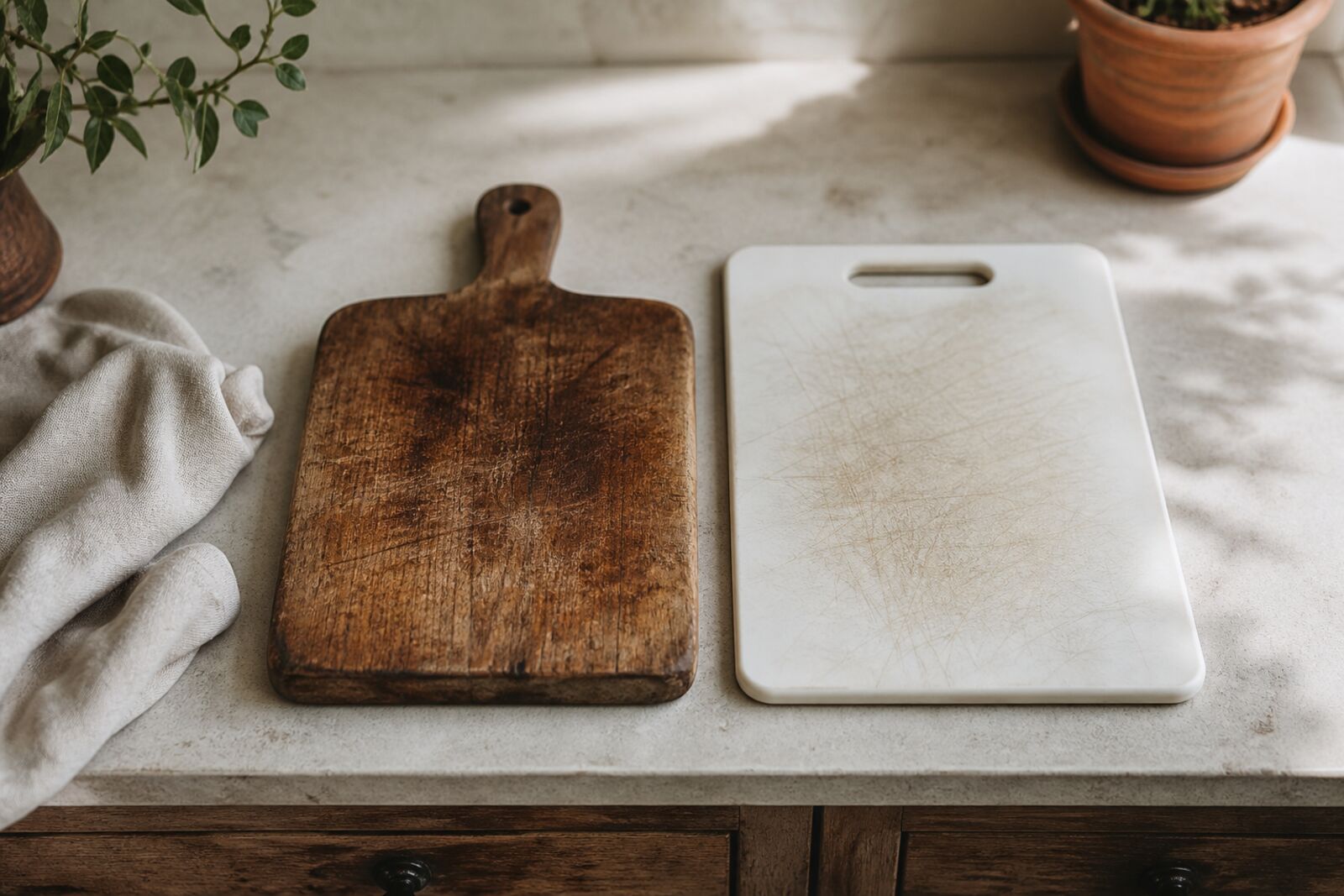
The short version
- A 2023 study in Environmental Science & Technology estimated that chopping on plastic boards could expose a person to tens of millions of microplastic particles a year. It counted particles. It did not find harm.
- The bacteria argument was largely settled at UC Davis in the 1990s, and it went the opposite way from what people assume: wood did not harbor more bacteria than plastic.
- Plastic's genuine advantage is the dishwasher, which is a real food safety tool for raw chicken.
- Wood or rubber for daily use, one cheap plastic board for raw meat if you want the dishwasher, and replace any plastic board that's deeply grooved.
Look at the surface of a plastic cutting board you've owned for two years. The grooves are visible, some deep enough to catch a fingernail. That material is gone from the board, and it went somewhere.
In May 2023, researchers writing in Environmental Science & Technology put a number on it. Chopping on polyethylene boards, they estimated, could expose a person to somewhere between 14.5 and 71.9 million microplastic particles a year, with polypropylene boards running higher at around 79.4 million. Chopping actual carrots released more particles than dry-run chopping, which is a nice detail: the food is part of the abrasive.
Those numbers are enormous and they traveled accordingly. Here's the part that traveled less.
Counting particles is not measuring harm
The same paper included a preliminary toxicity check. The polyethylene microplastics it collected did not reduce the viability of mouse fibroblast cells over 72 hours. That's a modest, early result and the authors treated it as one. It is also the only piece of health data in the study, and it points toward "no observed effect," not away from it.
This is where microplastics coverage keeps going wrong in both directions. The particles are real and they're in everything, including bottled water, salt, and human blood. What does not yet exist is a dose-response relationship in humans: nobody can tell you what quantity of ingested polyethylene produces what outcome, because the research hasn't gotten there. Anyone selling you a board on the strength of the health risk is selling ahead of the evidence, and anyone dismissing the finding as junk is ignoring a real measurement.
The honest position is that this is an unquantified exposure with a cheap and pleasant way to avoid it. Which is a good reason to switch boards and a bad reason to be afraid.
The bacteria question was settled, and everyone remembers it backwards
The conventional wisdom that plastic is more sanitary comes from a period when public health guidance leaned that way, on the reasonable-sounding theory that wood is porous and porous means harboring.
Dean Cliver's food microbiology lab at UC Davis tested it directly in the 1990s and found the opposite. Bacteria applied to plastic boards survived and multiplied. Bacteria applied to clean wood were drawn down into the surface within minutes and largely could not be recovered alive. His team ran the comparison across Salmonella, Listeria, and E. coli, and reported bacterial reductions in wood well above 98 percent. Cliver also pointed to a California case-control study of sporadic salmonellosis in which home cooks using wooden boards were less than half as likely to have been infected.
Two caveats, because they matter. Cliver's work included knife-scarred boards, and later experiments that disputed his conclusions often used only new, unscarred surfaces, which is not the board in your kitchen. And nobody, including Cliver, claimed wood is self-sterilizing. It's not a magic antimicrobial slab. It's a material that traps bacteria and lets them die rather than pooling them in a groove.
Current USDA guidance treats both materials as acceptable when they're cleaned properly and replaced when badly worn. That's the correct read.
What plastic genuinely wins
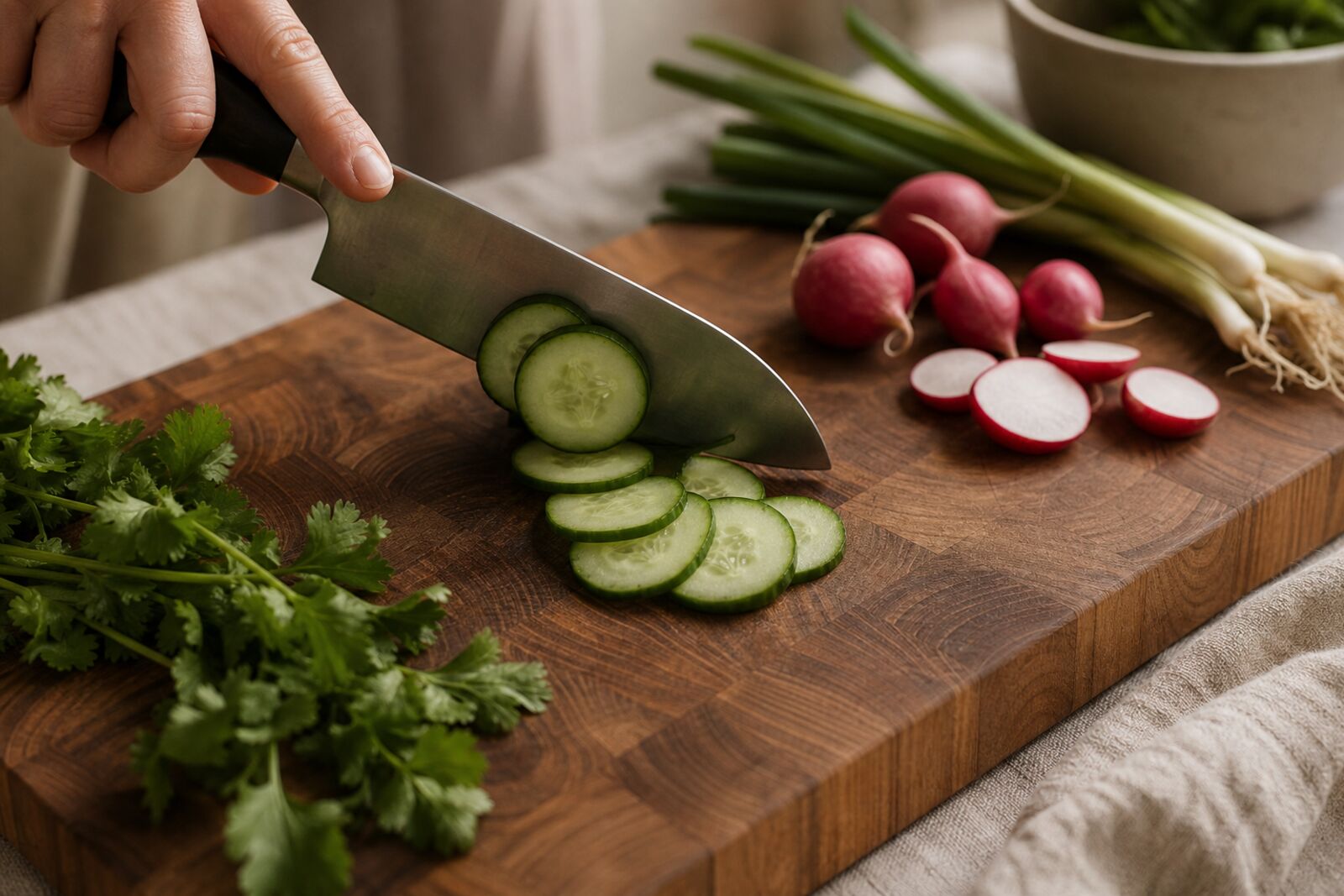
The dishwasher, and it's not a small thing. A dishwasher's heat and detergent are a legitimate sanitation step, and no wooden board survives one. If your household handles a lot of raw chicken and you'd rather not think hard about cross-contamination, a cheap plastic board dedicated to raw meat and run through the machine is a defensible, boring choice.
Cross-contamination is also the risk on this page with an actual body count. Campylobacter and Salmonella from poultry sicken people constantly. Microplastics, so far, have no established human dose. If you're going to spend worry on one of them, spend it on the chicken.
Plastic is also lighter, cheaper, and easier for anyone with wrist or grip problems to lift and clean. A twelve pound maple block is a genuinely difficult object for some people to use.
Rubber, bamboo, composite: the middle options
Rubber boards are what a lot of professional kitchens actually use. They're forgiving on knife edges, they don't slide, and they're effectively self-healing, so they don't develop the deep permanent scoring that plastic does. Sani-Tuff is the standard American version. They're heavy, they stain, and they're not cheap. And to be clear about it: rubber is a polymer too, so it isn't a microplastics-free answer, just a much slower-shedding one.
Epicurean makes boards from compressed wood fiber and resin that are dishwasher safe, which is a real advantage over solid wood. The trade is hardness. They're tough on knife edges compared to end-grain maple.
Bamboo is popular and we'd skip it. It's harder than maple, so it dulls knives faster, and bamboo boards are strips of grass laminated together with adhesive, which is more glue in your food-contact surface than a solid wood board has.
For solid wood, John Boos is the reference maker in the US, and the honest caveats are weight, price, and the fact that you have to oil it with food-grade mineral oil every month or so or it will dry out and eventually split.
How to keep any board safe
Wash it right after use in hot soapy water, and dry it standing on edge rather than flat. Never let a wooden board sit in a sink full of water, and never put one in the dishwasher.
Use separate boards for raw meat and for produce, which is the single highest-value habit in this entire article. If you want to sanitize after chicken, a dilute bleach solution is the standard, followed by a rinse and a thorough dry.
Replace plastic boards once the grooves are deep enough to trap food, because at that point you have both the bacteria problem and the shedding problem in one object. A wooden board with the same wear gets sanded flat and keeps going, which is the quiet argument for wood that nobody puts on the packaging.
Bottom line
Use wood or rubber for everyday chopping. Both outperform plastic on knife edges and neither develops the permanent grooves that make an old plastic board a genuine hygiene problem. Keep one cheap plastic board for raw meat if the dishwasher gives you peace of mind, and throw out any plastic board you can catch a fingernail in.