The short version
- No US agency defines "clean" or "natural" for cosmetics, so a green seal means "complies with this store's list", nothing more.
- Sephora screens out 50-odd ingredients. Credo screens out more than 2,700. Both call the result clean.
- Notre Dame researchers found evidence of PFAS in about half of 231 North American cosmetics tested, concentrated in the waterproof and long-wear products.
- The two moves that beat any seal: own fewer products, and buy fragrance-free.
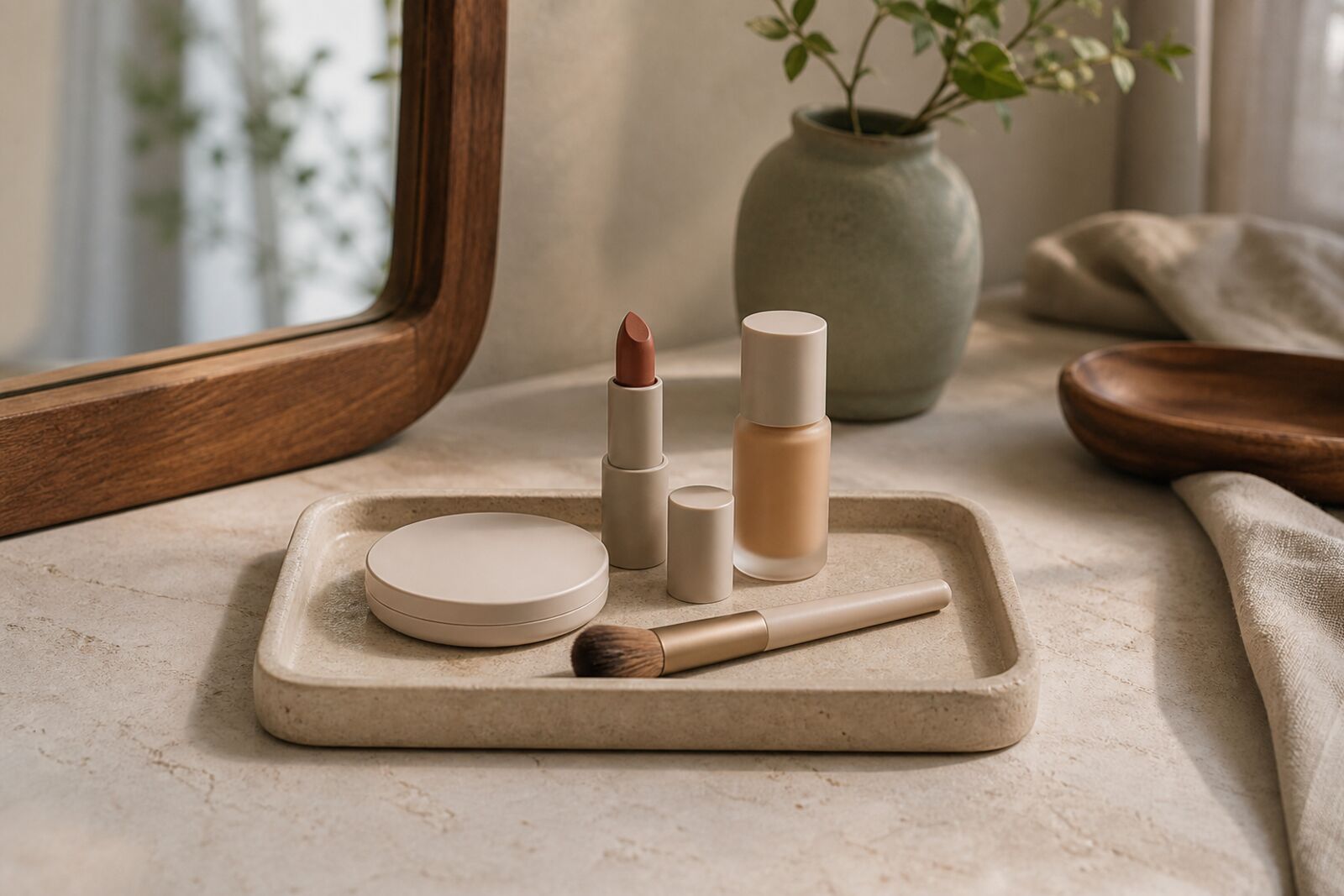
Walk into a Sephora and you'll see a small green leaf next to hundreds of products. Walk into a Credo and you'll see a different standard applied to a different set of products. Walk into a Target and you'll see a third icon. All three say clean. None of them mean the same thing, and no federal agency has an opinion on any of it.
That's not a scandal, exactly. Retailers filled a vacuum that regulation left open. But the word does no work for you at the shelf, so you need something that does.
Every seal is a private list, and they disagree with each other
The FDA has no regulatory definition for "clean" in cosmetics, and it doesn't define "natural" either. Any brand can print either word on a box tomorrow.
So retailers wrote their own rules. Clean at Sephora covers products formulated without roughly 50 flagged ingredients. Credo's Clean Standard restricts more than 2,700, along with a public Dirty List. Target Clean uses its own smaller set that varies by category. Whole Foods runs another standard on its shelves.
The gaps are the interesting part. Sephora's program still allows undisclosed synthetic fragrance under the "fragrance" umbrella, which is the single largest hole in any personal care label. Credo bans some ingredients Sephora permits and permits some that Sephora bans, and publishes its reasoning for the judgment calls, which is more than most.
None of this makes the programs worthless. A screened product is on average less likely to contain the ingredients you were worried about than an unscreened one. It just means the seal is a retailer's editorial position, not a safety certification, and swapping stores changes the answer.
The finding that actually justified some alarm
In 2021, researchers in Graham Peaslee's lab at the University of Notre Dame published a study in Environmental Science and Technology Letters screening 231 cosmetics bought in the US and Canada for total fluorine, a marker for PFAS. About half came back with high fluorine levels.
The distribution was the story. Roughly 82 percent of waterproof mascaras and 62 percent of liquid lipsticks had high fluorine, along with a majority of foundations and eye products. When the team ran targeted analysis on 29 high-fluorine items, they found between four and 13 individual PFAS in each. Almost none of them listed a PFAS on the label.
That last detail is what makes this different from most ingredient panics. You couldn't have avoided these by reading the box. The claims that predicted PFAS were performance claims: waterproof, transfer-proof, 16-hour, long-wear. Fluorinated compounds are used because they repel water and oil, which is exactly what those products promise.
Dose caveats still apply. Detecting a compound in a mascara is not a demonstration of harm from wearing mascara, and nobody has established what dermal exposure from cosmetics contributes to body burden compared with food and water. But when a chemical class is persistent and the exposure is daily and avoidable, skipping the waterproof formula on ordinary days is a cheap call.
Talc, asbestos, and a reclassification that got misread
In July 2024, the World Health Organization's International Agency for Research on Cancer classified talc as probably carcinogenic to humans, Group 2A. Headlines treated that as proof, which is not what a 2A means.
The working group cited limited evidence in humans, sufficient evidence in animals, and strong mechanistic evidence. They were explicit that the consistent increase in ovarian cancer among women reporting perineal body powder use could not be cleanly separated from two confounders: documented asbestos contamination in some talc, and recall bias in the studies themselves. Talc containing asbestos was not re-evaluated; it stays in Group 1 with asbestos, where it has always been.
The historical problem here is contamination, not the mineral's presence in a compact. Talc and asbestos form in the same geology, and testing methods for detecting one in the other have been argued about in courtrooms for decades. Johnson and Johnson pulled talc-based baby powder from the US and Canada in 2020 and went to cornstarch globally in 2023, while maintaining its product was safe, against tens of thousands of claims.
For loose powders you inhale near your face, cornstarch and rice starch alternatives exist and cost about the same. For a pressed powder in a compact, this is not the thing to lose sleep over.
MoCRA gave the FDA teeth, finally
The Modernization of Cosmetics Regulation Act, signed in December 2022, was the biggest expansion of FDA cosmetics authority since 1938. Before it, the agency could not order a cosmetics recall. It could ask.
Now manufacturers must register facilities and list products, keep safety substantiation records, report serious adverse events within 15 business days, and the FDA can mandate recalls and suspend registrations. There's also a requirement to disclose fragrance allergens on labels, with implementation still being worked out.
This is meaningful and modest. MoCRA doesn't pre-approve ingredients the way the EU system does, and it doesn't define "clean". It mostly means somebody now has to answer the phone.
What we'd actually do at the shelf
Own less. A five-product routine from an unscreened brand exposes you to fewer distinct chemicals than a fifteen-product routine of certified-clean everything. Nobody selling you a seal will tell you this, because it's the one strategy with no revenue attached.
Buy fragrance-free. Fragrance mixes are among the leading causes of cosmetic contact dermatitis and they're the one category legally allowed to hide its contents. "Unscented" is not the same claim and can mean a masking fragrance was added.
Skip waterproof and 16-hour claims for daily wear, since that's where the PFAS clustered. Save them for the wedding.
On seals: EWG Verified is the stricter mark, and it requires full disclosure of all ingredients including those in fragrance, which no retailer program demands. We'll also say the uncomfortable part, since EWG is normally on our side of these fights. EWG's Skin Deep hazard scores are hazard-based rather than risk-based, meaning they score a molecule on what it can do at any dose rather than what your exposure actually is, and they penalize ingredients for missing data. That's a defensible way to build a precautionary tool and a bad way to decide that a well-formulated preservative is dangerous. Use the Verified mark, take the numeric scores lightly.
Then favor brands that publish complete ingredient lists in plain sight. LA-based Truly Beauty, for instance, sells itself on being clean and vegan, and that "clean" is the company's own claim rather than a certification, which is precisely how you should read every brand making it. Full disclosure beats the adjective every time.
Bottom line
Buy less makeup, buy fragrance-free, and skip the waterproof and long-wear formulas for everyday use, because that's where the PFAS actually showed up. Treat retailer clean seals as a store's shopping list rather than a safety verdict, and give more weight to any brand that publishes its full ingredient list, fragrance included.