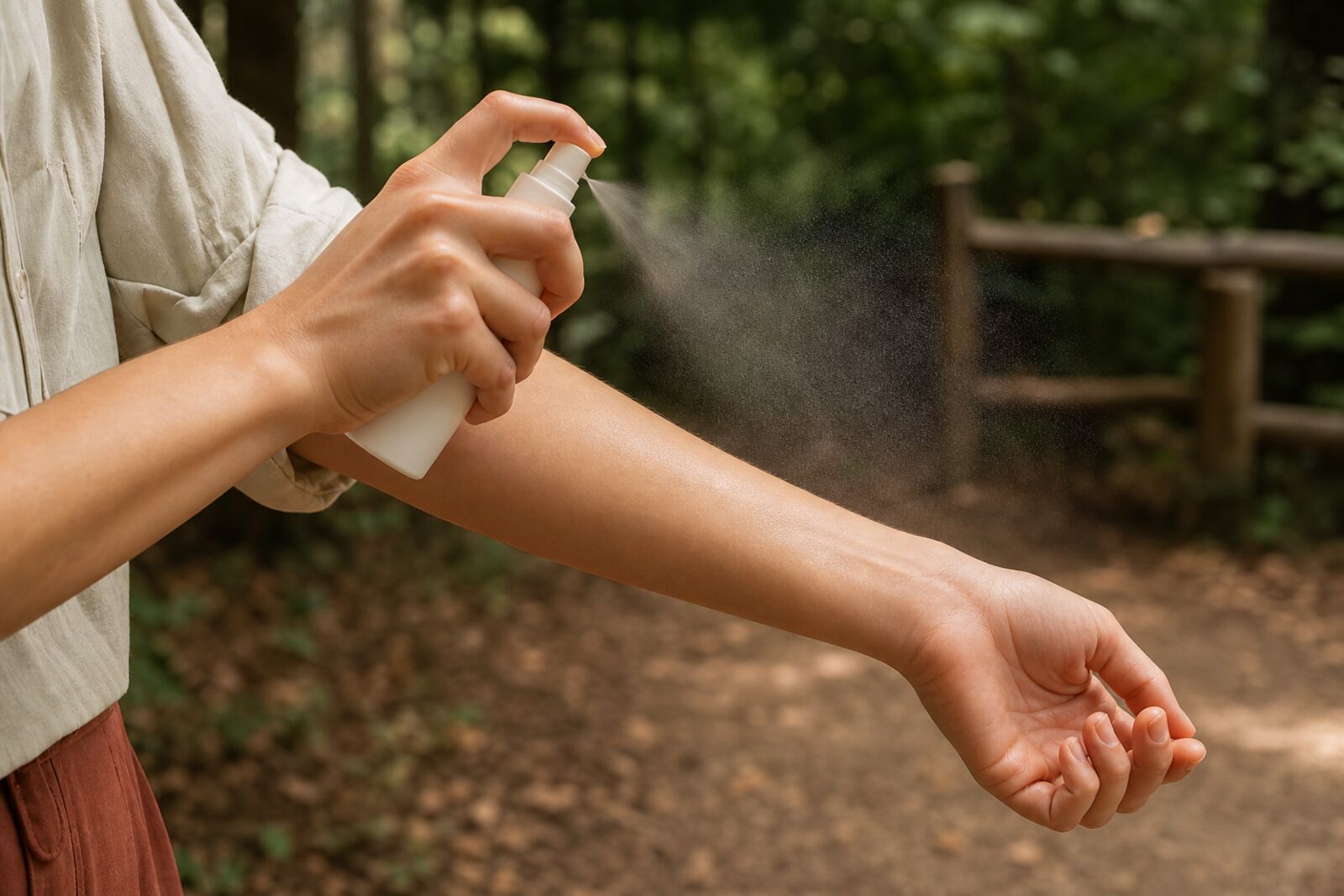
The short version
- DEET has been in consumer use since 1957 and the American Academy of Pediatrics clears it at 30% or lower for babies over two months.
- Picaridin at 20% is the daily driver: comparable protection, no solvent smell, doesn't wreck plastic.
- Citronella candles and repellent wristbands failed in controlled testing. Oil of lemon eucalyptus is the one plant-derived exception, and only the EPA-registered kind.
- Permethrin on your clothes is the most underused product in the category, especially for ticks.
The label rule that does most of the work
Look for "EPA-registered" on the can. That phrase means the product went through a federal review of both safety and efficacy, and it's the line CDC draws between repellents worth using and repellents worth ignoring. The registered actives are a short list: DEET, picaridin, IR3535, oil of lemon eucalyptus and its refined form PMD, and 2-undecanone. Anything not on that list is asking you to take its word for it.
That single filter removes most of the shelf, including nearly everything sold with a leaf on the label.
DEET's reputation is worse than its record
DEET has been on the US consumer market since 1957, and EPA has reviewed it repeatedly, most recently concluding that normal use doesn't present a health concern. The scary case reports that circulate are overwhelmingly from gross misuse: enormous doses, ingestion, days of saturation.
The pediatric guidance is the part people find surprising. The American Academy of Pediatrics says DEET at concentrations of 30% or lower is safe for children, and can be used on infants older than two months. That's a body famous for erring toward caution.
Concentration governs duration, not strength. In the reference study on this, Mark Fradin and John Day's 2002 New England Journal of Medicine trial, a 23.8% DEET product held off mosquito bites for 301.5 minutes on average, a 20% product for 234.4 minutes, 6.65% for 112.4 minutes, and 4.75% for 88.4 minutes. There's no reason to buy 98% DEET. Above roughly 30% you're mostly buying a longer wait before reapplication, and a stronger solvent that will happily fog your sunglasses and soften your watch strap.
Picaridin is the one to keep in the bag
Picaridin does the same job without the personality problems. Consumer Reports' repellent testing has found 20% picaridin products effective against mosquitoes and ticks, and it's odorless once dry, doesn't feel like paint thinner, and doesn't attack plastics or synthetic fabric.
Sawyer's 20% picaridin spray is the version most widely stocked and the one we'd hand to someone who has never thought about this before. The lotion form lasts longer than the pump spray but goes on greasy, and neither is cheap for the bottle size. That's the whole complaint list.

Where "natural" collapses
Citronella wristbands are the clearest failure. Fradin and Day tested repellent-impregnated wristbands and found they provided effectively no protection, and that includes bands loaded with 9.5% DEET, which tells you the format is the problem. A 2017 study in the Journal of Insect Science found citronella wristbands had no significant repellent effect, and work from the London School of Hygiene and Tropical Medicine found no meaningful protection at the wrist and none at all at the ankle or face. Consumer Reports has put wristbands, citronella candles, and ultrasonic devices on its list of repellents to skip.
Most botanical sprays fare only slightly better: measurable protection, measured in minutes, not hours.
The exception is oil of lemon eucalyptus, refined into PMD. It's EPA-registered, it's on CDC's recommended list, and in Consumer Reports testing 30% OLE products performed well. Repel's lemon eucalyptus spray is the common drugstore version and works, with two caveats worth knowing: it smells strongly of eucalyptus for the first half hour, and it isn't for children under three because of skin irritation. Also, and this trips people up constantly, the refined OLE repellent is not the same thing as a bottle of lemon eucalyptus essential oil from the wellness aisle. The essential oil hasn't been tested or registered as a repellent. Do not substitute one for the other.
What to reach for, and when
| Product | Use it for | Honest note |
|---|---|---|
| Picaridin, 20% | Everyday summer, city travel, kids' camp | Effective in Consumer Reports testing, no smell, safe on gear. The default. |
| DEET, 25% to 30% | Deep woods, dusk in mosquito country, long exposure | Around five hours of protection. Keep it off plastic lenses and painted surfaces. |
| Oil of lemon eucalyptus, 30% | People who want a plant-derived option that works | Real efficacy, strong smell, not for kids under three. Not interchangeable with the essential oil. |
| Permethrin, 0.5%, on clothing | Ticks, hiking, yard work, anywhere Lyme lives | Goes on fabric, never on skin. Highly toxic to cats while wet. |
| Citronella candles, wristbands, ultrasonic | Ambiance | Failed controlled testing. Light the candle because you like it. |
Permethrin is the product almost nobody buys
Skin repellents are a defense. Treated clothing is closer to a perimeter, and for ticks it's the better tool.
CDC recommends treating clothing and gear (boots, pants, socks, tents) with 0.5% permethrin, and its own 2018 lab work found treated fabric strongly impaired ticks: after a one-minute exposure, 100% of blacklegged tick nymphs, the ones that spread Lyme, had lost normal movement an hour later. In a randomized trial among outdoor workers, factory-treated clothing cut tick bites by 65% in the first year and 50% in the second.
Sawyer's permethrin spray is the standard consumer version and treats clothing for roughly six washes. Two rules: it goes on fabric only, never skin, and it has to dry completely before wear. If you have a cat, treat clothing outside and keep the cat away until everything is bone dry, because wet permethrin is seriously toxic to cats. Consumer Reports has a good walkthrough of the application steps if you want one.
Remember what's being prevented
The risk math here is lopsided in a way the "is DEET safe" question tends to hide. West Nile virus circulates across most of the continental US. CDC has said the number of Americans actually diagnosed and treated for Lyme disease each year is many times the number captured by formal surveillance. Dengue's range keeps expanding, and locally acquired cases have turned up in the southern US in recent years.
Against that, the downside of a well-registered repellent is a slightly greasy forearm.
Bottom line
Buy 20% picaridin for daily use, keep a 25% to 30% DEET spray for the woods and the worst evenings, and treat your hiking shoes and pants with 0.5% permethrin if you're anywhere ticks live. Oil of lemon eucalyptus is a legitimate plant-derived option if you want one, as long as it's the EPA-registered product and not the essential oil. The citronella candle is for the table, not for you.